Greece volcano cams
The South Aegean volcanic arc runs from the Saronic Gulf to the Dodecanese, where the African plate slides under the Aegean. Its volcanoes are quieter than Italy's, and older in the record: this is where a single eruption in the Bronze Age changed the map.
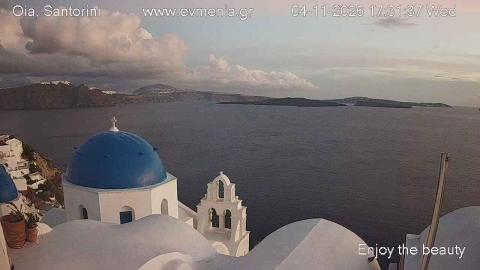
What is here so far
Santorini, for now. It is the one Greek volcano with cameras that actually look at the volcano: the caldera is the view from every cliff-top village on the island, so the cameras that hotels and local sites keep pointed at the sunset happen to be pointed at it too.
The rest of the arc
Four other centres on the arc are counted as active. Methana, on a peninsula near Athens, last erupted in the third century BC. Milos and Nisyros both have hot ground and fumaroles — the crater floor of Nisyros, Stefanos, can be walked across — and Nisyros last erupted in 1888. Kolumbo, the most likely to erupt next, is seven kilometres from Santorini and entirely underwater. None of them has a public camera pointed at the volcano rather than at the harbour, which is why this page is short; when one appears, it goes here.
When to watch
Greece is two hours ahead of UTC in winter and three in summer. Summer in the Cyclades is dry, bright and hazy, with the northerly meltemi wind blowing for days at a time; the clearest air comes in spring and after autumn rain. The cameras face the caldera from the west-facing rim, so the best light is in the last hours of the day.