Southeast Asia volcano cams
Indonesia and the Philippines have more active volcanoes between them than any other part of the world. The five here are among the best known, and most of them erupt close to densely populated land.
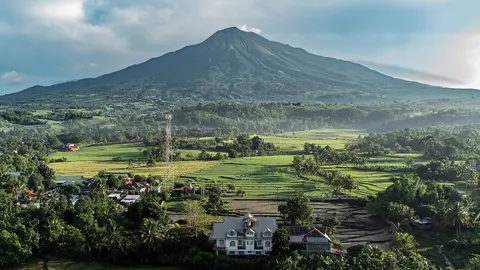
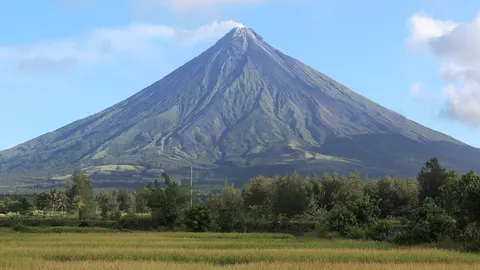
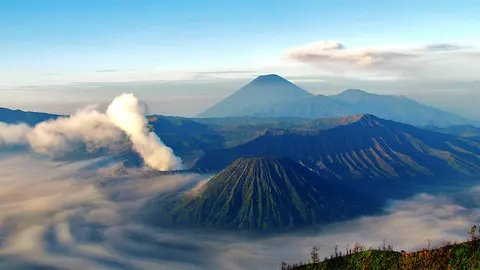

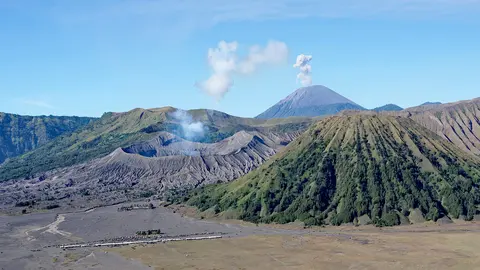
Photos: authors and licences of the 5 images
- Mount Merapi: Fahmi Widayat, CC BY-SA 4.0
- Semeru: Jakub Hałun, CC BY-SA 4.0
- Mayon Volcano: Patrickroque01, CC BY-SA 4.0
- Kanlaon: Bien02, CC BY 4.0
- Mount Bromo: Riza Nugraha, CC BY 2.0
Who runs these cams
The Merapi stream is run by Badan Geologi, Indonesia's Geological Agency, whose volcanology centre keeps observation posts manned around each of the country's active volcanoes. The others come from afarTV, which installs its own 4K cameras at active volcanoes and streams them continuously.
Five volcanoes worth knowing
Merapi rises 2,910 metres above the city of Yogyakarta and is the most closely watched volcano in Indonesia. It works by growing a lava dome at the summit until part of it collapses, sending pyroclastic flows down one flank — which is why the cameras are placed to cover specific valleys rather than the peak alone.
Semeru, at 3,676 metres, is the highest mountain in Java and one of the few volcanoes anywhere that produces small ash explosions on most days of the year. Bromo, in the same national park, is the opposite kind of sight: a low steaming cone in the middle of a sand-filled caldera, with Semeru on the horizon behind it.
In the Philippines, Mayon is the one people recognise: a cone of almost perfect symmetry above the province of Albay, with a history of sudden lava flows. Kanlaon, on the island of Negros, is quieter but sits among sugar farms and hill villages, so even modest ash falls matter there.
Alert levels, and what they mean
Indonesia rates its volcanoes from I (Normal) to IV (Awas); the Philippine institute PHIVOLCS uses 0 to 5. Each page shows the level for its volcano, taken from the official source. A raised level usually means unrest and an exclusion zone, not an eruption in progress.
Cloud and timing
Tropical volcanoes are often hidden by cloud from late morning onward. The clearest views usually come at dawn, and at night the glow of lava domes and explosions can break through thin cloud. Java is seven hours ahead of UTC and the Philippines eight. Java's wet season runs from November to March; the Philippines can be affected by typhoons between June and November.