What you can see on the Mayon cams
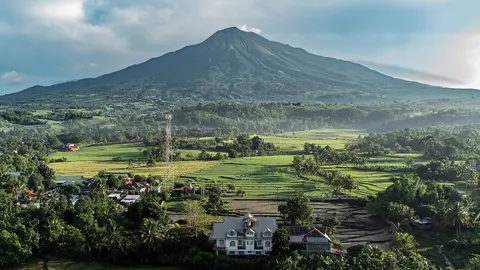
The livestream faces Mayon’s cone. When the volcano is active, the summit glows at night, and lava flows and rockfalls leave bright streaks down its steep upper slopes. By day, a white plume of steam often trails from the crater.
Eruptions of Mayon
Mayon has erupted around 50 times since records began. In 1814, pyroclastic flows buried the town of Cagsawa, where the ruined church tower still stands today. More recent eruptions, in 2018 and 2023, brought lava fountains and slow lava flows down the slopes and forced tens of thousands of people to evacuate. PHIVOLCS, the Philippine Institute of Volcanology and Seismology, keeps a permanent danger zone around the summit.
When to watch Mayon
The cone is clearest early in the morning and after rain clears the air. At night, glowing lava is visible even in light cloud when the volcano is erupting. The Philippines is eight hours ahead of UTC.
Around Mayon
At Cagsawa, a bell tower is all that remains of the church buried by the eruption of 1814, with Mayon rising perfectly behind it. Legazpi, the provincial capital, has viewpoints and boulevards facing the volcano, and tours cross its old lava and lahar deposits by all-terrain vehicle. The waters off Donsol, in neighbouring Sorsogon province, are known for whale sharks.
Visiting Mayon
Climbing Mayon has been restricted for years because of its frequent activity, and a permanent danger zone surrounds the summit. The best way to enjoy it is from the viewpoints around Legazpi and the Cagsawa ruins, ideally early in the morning.