Réunion volcano cams
Réunion is a volcanic island of about 2,500 km² in the western Indian Ocean, 700 km east of Madagascar and part of France. It is made of two volcanoes standing side by side: Piton des Neiges, extinct and eroded into three huge amphitheatres called cirques, and Piton de la Fournaise, young and still erupting.
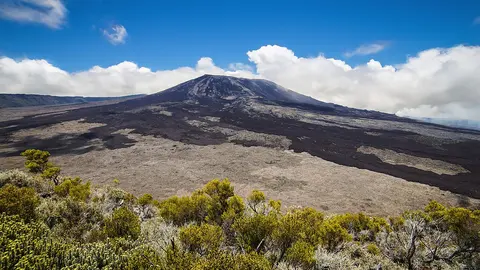
Photos: Piton de la Fournaise: Alexandre Péribé, CC BY-SA 4.0.
Who runs these cams
The cameras belong to the Observatoire Volcanologique du Piton de la Fournaise, which the Institut de Physique du Globe de Paris has run on the island since 1979. They exist to watch the volcano, not the scenery, so they are placed where an eruption would show first: on the summit craters, on the cone and around the caldera rim.
A hotspot volcano
Réunion sits above a hotspot, a plume of hot rock rising from deep in the mantle, the same kind of source that feeds Hawaiʻi. The plume is old: over the last 65 million years it built a chain of volcanoes on the ocean floor as the plates moved over it, and some scientists link its first eruptions to the vast lava flows of India's Deccan Traps. Piton de la Fournaise is its newest volcano, about half a million years old, and it produces the same fluid basaltic lava as Kīlauea.
When to watch
Réunion is on UTC+4 all year. The summit is usually clearest in the early morning, before trade-wind cloud piles up against the eastern slopes; the western side of the island stays drier. The cool, dry season from May to October gives the best views.