

What you can see on the Fournaise cams
The cams cover the whole summit of the volcano, from inside its craters to the long views across the Enclos Fouqué, the caldera that holds the active cone. When the volcano is quiet they show a bare landscape of lava, cinders and cliffs; when an eruption starts, the glow and the new flows can be seen day and night. Cloud tends to build over the mountain through the day, so mornings are the clearest. Each frame carries the time it was taken, in UTC.
The summit cone from the floor of the Enclos
From the floor of the Enclos Fouqué, the great horseshoe-shaped caldera that holds the active cone, this camera looks up at the summit of Piton de la Fournaise. The cone rises in a smooth, reddish-brown dome of old lava and cinders to the rim at the top, and the ground in front is a rough plain of lava, with a small dark pit in the middle distance.
It faces the morning sun, so the early hours bring glare across the frame. When an eruption opens fissures on the flanks, this is the view where the first glow and the new flows show, day or night.
Into Dolomieu, the summit crater that collapsed
On the eastern rim of Dolomieu, the camera looks across the large summit crater. Its walls drop in steep, layered cliffs of grey and reddish rock, and the floor lies far below; the camera's own housing darkens the lower edge of the frame. In April 2007 the floor of Dolomieu collapsed by more than 300 metres in a few days, during the largest eruption of the past century, leaving the deep pit seen today.
In the early morning the sun shines straight into the crater from behind the far wall and the floor washes out to white. The walls show their layers best later in the day.
Down the funnel of Bory crater
This camera stands inside Bory, the older and smaller of the two summit craters, and looks down its steep funnel. Walls of loose scree and dark rock slope in from both sides to a narrow floor, and the far rim closes the skyline above. It is the most enclosed of the Fournaise views, close enough to see the texture of the rock.
Bory sits just west of Dolomieu, and the summit trail from the Pas de Bellecombe ends between the two when the volcano is quiet. Facing the morning sun, the crater is in deep shadow early on, with reflections across the lens.
The cone on the skyline across the lava plain
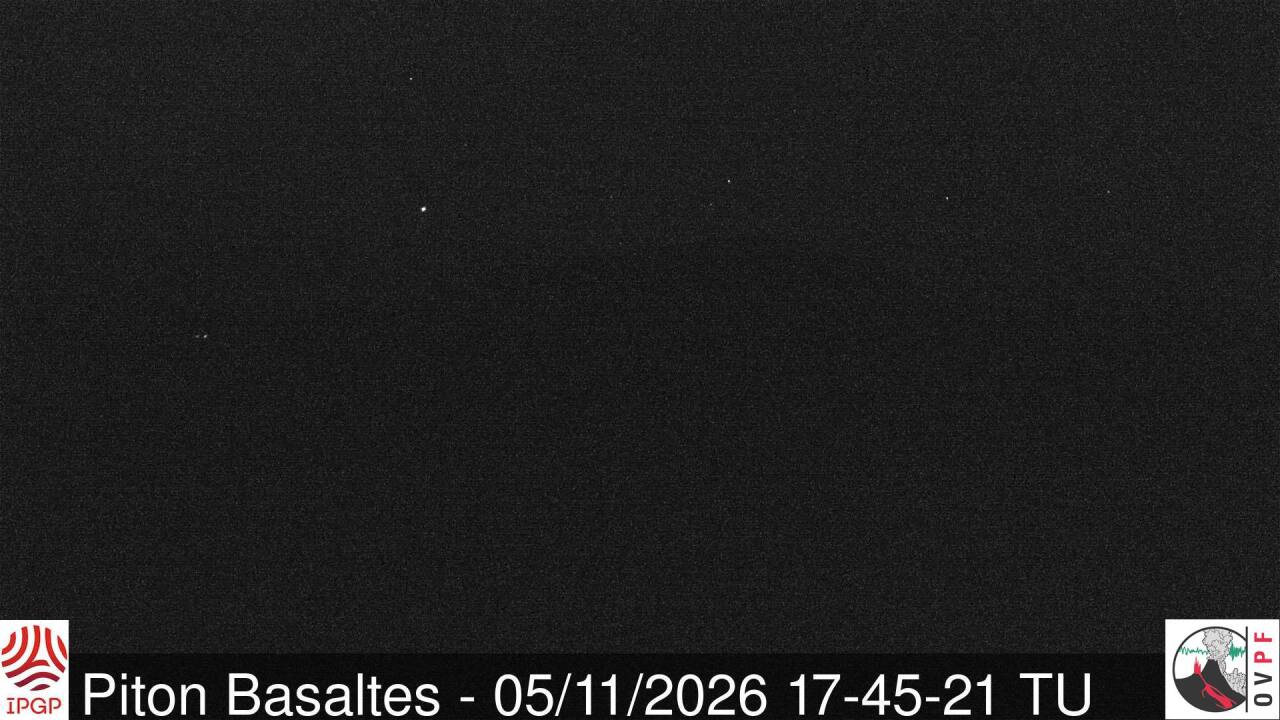
From Piton Basaltes, the camera looks over low, dense scrub to the dark lava plain of the Enclos and the summit cone of Piton de la Fournaise rising on the skyline. On the left, the cliffs of the caldera wall run off into the distance, and on clear mornings the sea of clouds can show beyond the far edge.
It is a long view rather than a close one, which makes it good for reading the weather on the summit and for seeing a plume or the glow of an eruption from a distance. Raindrops on the housing sometimes streak the picture.
The broad flank of the volcano above the clouds
From Piton Partage, the camera looks across a slope of green scrub and heather-like bushes to the broad, dark flank of Piton de la Fournaise, which fills most of the frame and rises to the summit on the right. On the left, the sea of clouds often lies below the level of the camera, and a pale mast of the monitoring station stands in the foreground.
Cloud tends to build over the mountain as the day goes on, so the morning hours give the clearest views, with the sun lighting the flank from the side.
An eruption that stays inside its walls
Most of the activity happens inside the Enclos Fouqué, a horseshoe-shaped caldera about 9 km wide whose open side faces the sea. Lava that leaves the summit usually runs east down the Grand Brûlé slope, where the coast road crosses flows only a few years old, and sometimes reaches the ocean. That geography is why a volcano this active is so rarely a danger to the towns around it. In April 2007 it produced its largest eruption in a century: lava poured into the sea and the floor of Dolomieu collapsed by more than 300 metres in a few days.
When to watch Piton de la Fournaise
Mornings are clearest; cloud usually builds over the summit by early afternoon. Réunion is four hours ahead of UTC all year, so the best light falls in the early morning in Europe. During an eruption the lava shows best after dark.
Around Piton de la Fournaise
The road up crosses the Plaine des Sables, a bare plain of red and grey cinder. Piton des Neiges, the island's extinct and higher volcano, rises to the northwest; together with the cirques and ramparts around them, the island's interior is a UNESCO World Heritage Site.
Visiting Piton de la Fournaise
The usual walk starts at the Pas de Bellecombe viewpoint, drops into the caldera past the small crater of Formica Leo and climbs to the summit craters. When the observatory signals an eruption or rising unrest, the caldera is closed to visitors.