INGV Osservatorio Etneo
The Catania branch of Italy’s National Institute of Geophysics and Volcanology, in charge of monitoring Etna, Stromboli and Vulcano.
INGV, Italy's National Institute of Geophysics and Volcanology, was formed in 1999 by merging the country's geophysical institutes into one body. Among them was the Osservatorio Vesuviano, founded in 1841 on the slope of Vesuvius and still the oldest volcano observatory in the world; it remains INGV's Naples section, in charge of Vesuvius and Campi Flegrei.
The Osservatorio Etneo
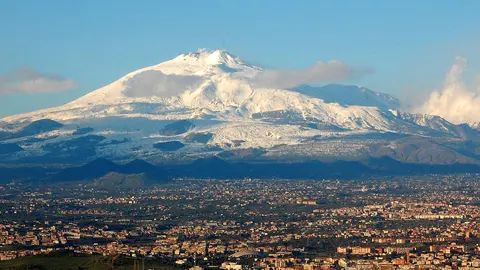
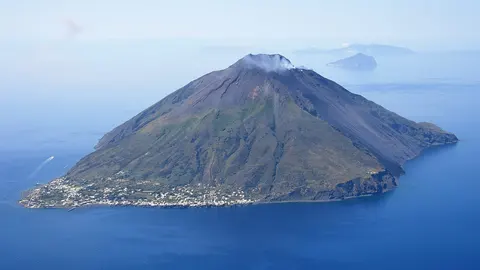
The Catania section, the Osservatorio Etneo, watches Etna, Stromboli and Vulcano. It is one of the most heavily instrumented volcanic areas anywhere: dozens of seismic stations, GPS receivers that measure the mountain stretching, gas sensors on the summit craters, and a camera network that mixes ordinary daylight views with thermal ones.
Why the thermal cameras matter
Etna and Stromboli are usually wrapped in their own fume, and that is exactly when something is happening. A thermal camera reads temperature rather than light, so it picks out hot material through the haze and at night, and it shows a lava flow's front advancing when a daylight view shows only grey. The official streams cycle through several cameras, so the view changes every few seconds — wait a moment and a thermal frame comes round.
Licence and player
INGV publishes two channels, one for Etna and one for the Aeolian Islands, under a Creative Commons Attribution 4.0 licence. They play here from garr.tv, the video service of Italy's research and university network, which is where INGV hosts them.
Volcanoes with INGV Osservatorio Etneo cams
INGV Osservatorio Etneo in numbers
- Cams
- 2 cams · 2 places · Italy
- How you watch them
- 2 as live video
- Right now
- 2 of 2 broadcasting
- Terms
- CC BY 4.0
Website: ct.ingv.it.