
What you can see on the Etna cams
Etna shows itself in two ways: the summit craters up close, often in thermal light that picks out hot ground through the gas, and the whole mountain from the villages on its flanks, a long dark mass under a cap of cloud or snow. The 24-hour replays are the quickest way to see what the summit did overnight.
Etna in heat and in daylight, from the observatory
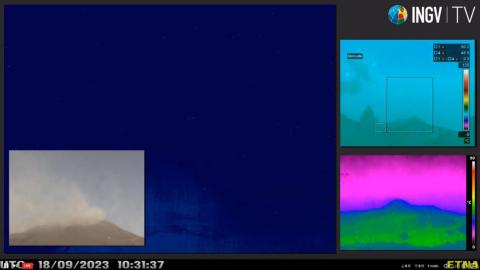
This is the surveillance channel of the INGV's Etna Observatory, and it shows the summit as the scientists watch it. The main picture is often a thermal view, in which the cold sky turns deep blue and warm ground shows green, yellow and white along the summit craters; a small daylight view sits in one corner and other thermal frames down the side. The channel moves between cameras around the mountain, so the angle changes.
Thermal cameras see through the gas plume and work in the dark, which makes this the view to check when Etna is restless: a new vent, a lava flow or a fountain shows as a bright streak at once.
The long northern flank of Etna
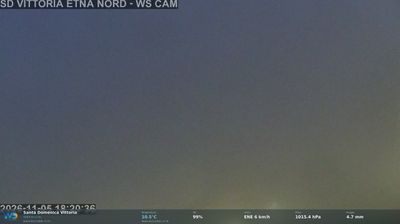
From Santa Domenica Vittoria, a village on the Nebrodi side to the north, the camera looks across a wide valley to the whole northern flank of Etna. The mountain fills the frame as one long, gently rising mass, dark with forest and lava on its lower slopes, with the summit area on the skyline, often under a cap of cloud or dusted with snow in the cold months. Woodland edges the lower right corner.
Seen from this side, Etna shows how big it is: it is the largest active volcano in Europe, and its base is about 40 km across. Early morning light reaches this flank from the side.
How Etna erupts
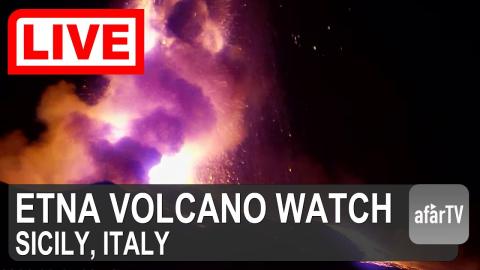
Etna has four summit craters, and the youngest, the Southeast Crater, has been the most active in recent years. Its best-known events are paroxysms: short episodes when lava fountains hundreds of metres high and ash columns kilometres tall burst from the summit, often at night. Between paroxysms there are long periods of Strombolian activity, small explosions of glowing lava, and lava flows down the uninhabited Valle del Bove on the eastern flank. Ash can close Catania’s airport for hours.
Etna was added to UNESCO’s World Heritage list in 2013.
When to watch Etna
Night is best for explosions and lava; the thermal cameras show activity at any time. Italy is one hour ahead of UTC in winter and two in summer.
Around Etna
The Circumetnea railway runs almost all the way around the volcano through lava fields, orchards and villages. Vineyards on the slopes produce the Etna DOC wines, grown in volcanic soil. From the ancient Greek theatre of Taormina, on the coast to the northeast, the volcano rises above the sea in one of the most famous views in Sicily.
Visiting Etna
The main access points are Rifugio Sapienza on the south side and Piano Provenzana on the north. A cable car climbs to about 2,500 m (8,200 ft), and the summit area can only be visited with an authorised guide, within limits that change with the volcano’s activity.