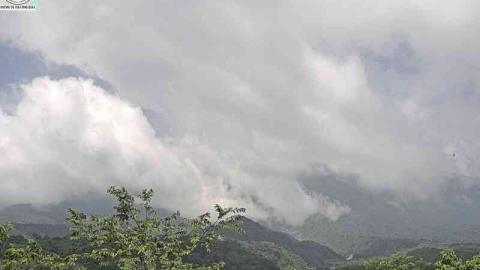
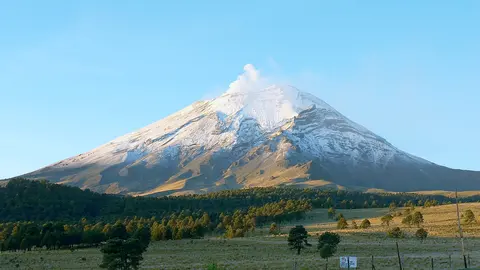
What you can see on the Santa María cam
The camera faces the dome complex from the south in 4K, at a distance close enough to make out individual explosions. Santiaguito works on a rhythm: gas and ash build under the crusted top of the dome until it fails, and a grey column pushes out — often several times an hour, occasionally with a pyroclastic flow running down the front of the dome. Between explosions the dome simply steams. On the horizon behind it, the cone of Santa María itself rises intact, which gives an unusually clear sense of how much of the mountain the 1902 eruption removed.
One of the largest eruptions of the twentieth century
The 1902 eruption was among the biggest anywhere in the last two hundred years. It had no known precedent in local memory — the volcano had been quiet through all of recorded history — and it dropped ash across Guatemala and beyond, ruining the coffee harvest and killing thousands. Twenty years later, in 1922, lava began to rise in the crater it had blown open, and Santiaguito has been active almost continuously since. It is one of the longest-running eruptions on earth, and one of the few places where a dome can be watched building and failing over and over.
When to watch Santa María
Guatemala is six hours behind UTC all year and does not use daylight saving. Mornings are the reliable window: cloud usually builds over the highlands by late morning and can hide the dome for the rest of the day, especially in the rainy season from May to October. Explosions happen at any hour and their glow can show at night when the dome is hot.
Around Santa María
Quetzaltenango, known locally as Xela, sits below the volcano and is the second city of Guatemala. The Pacific slope beneath Santiaguito is coffee country, and the rivers that drain the dome carry volcanic debris down it after heavy rain. Fuego and Acatenango are about 80 kilometres east.
Visiting Santa María
The summit of Santa María is a hard pre-dawn walk of three to five hours from the village of Llanos del Pinal, usually done with a guide, and the reward is looking down onto Santiaguito from above. The dome itself is off limits: the danger is not only the explosions but the flows and the hot avalanches that follow them.