What you can see on the Lanín cam
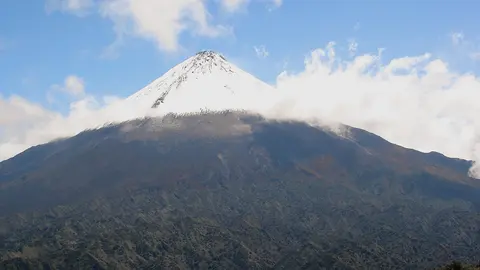
Lanín stands apart from the range, so there is nothing to confuse it with: the snow line, the rock ribs on its flanks and the summit cap are all easy to read. The forest at its foot is araucaria, the monkey puzzle tree native to this part of the Andes, and in winter everything goes white from the tree line up.
Lanín above the forest of its national park
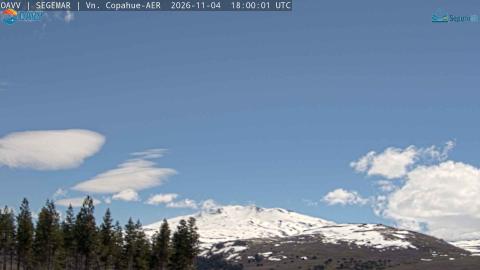
From the Argentine side, east of the mountain, the camera looks across a band of forest to Lanín, its upper slopes white with snow. From this angle the summit shows two tops, the peak itself and a lower shoulder beside it. Lanín stands on the border with Chile and reaches 3,747 m; it is the symbol of the national park that carries its name.
Cloud often catches the summit in the afternoon, so mornings are the safest time to see it. Each image carries the time it was taken, in UTC.
A mountain with two names and no recent eruptions
Lanín has not erupted in centuries, and its record before that is poorly known; what it has instead is meaning. It is sacred to the Mapuche, whose communities live around it on both sides of the border, and the name itself is Mapudungun. The Argentine national park that carries its name and the Chilean park on the other side together protect one of the last large stands of araucaria forest, some of the trees over a thousand years old.
When to watch Lanín
Argentina is three hours behind UTC all year. The southern summer, December to March, is the clear season and the climbing season; winter brings snow and weeks when the cone is hidden. The camera faces west, so mornings have the light behind the viewer and give the sharpest view.
Around Lanín
Lake Huechulafquen sits at its foot on the Argentine side, with the classic view along the water to the cone. San Martín de los Andes is the nearest town, an hour away, and the road over the Mamuil Malal pass crosses into Chile beside the mountain.
Visiting Lanín
The climb from the Argentine side takes two days with a night in a refuge, needs crampons and axe on the upper snow, and requires registering with the park, which limits numbers and checks equipment. The lower trails and the lakeshore are open to anyone.