
What you can see on the Mauna Kea cams
The cams look across the summit from two of its observatories, one facing east over the telescope domes and one facing west along the summit ridge. By day they show red cinder cones, white domes and, very often, a sea of clouds far below. After dark they become a window on one of the clearest skies on Earth, with stars, the Milky Way and, on the right nights, meteors.
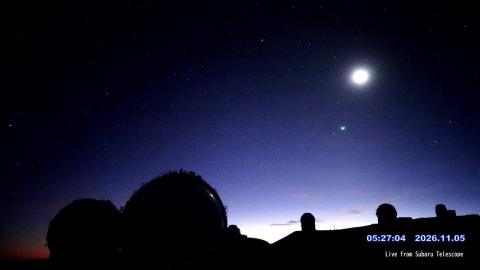
The twin domes of Keck from the Subaru Telescope
From the Subaru Telescope, near the top of Mauna Kea, the camera looks east along the summit ridge. The two large white domes on the left are the twin Keck telescopes, and smaller domes stand along the dark skyline to the right. Above them the sky at more than 4,100 m is a deep blue, and the sea of clouds often lies far below.
The camera faces the sunrise, so mornings come with a bright sun in the frame. After dark it turns to the stars, and on clear nights it shows the Milky Way rising over the domes.
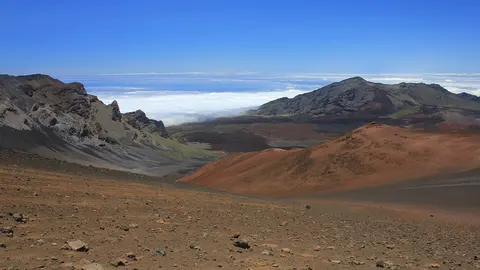
Cinder cones and domes along the summit ridge
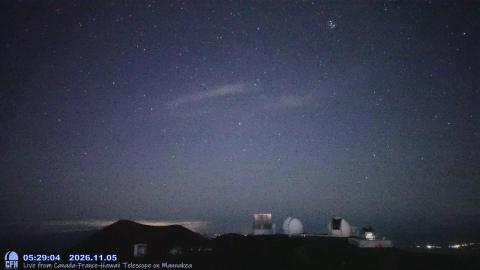
From the Canada-France-Hawaii Telescope, the camera looks west across the top of Mauna Kea. Red and brown cinder cones roll away in the foreground, the summit road winds below them, and a line of white and silver telescope domes stands on the ridge to the right. Beyond, the sky meets a hazy ocean or a bank of cloud, far below the summit.
Facing west, it catches the sunset straight on, and the domes glow in the last light. After dark it shows the night sky over the observatories, one of the darkest and clearest on Earth.
Mauna Kea across the saddle, from Mauna Loa
The camera stands at NOAA's Mauna Loa Observatory, about 3,400 m up on the north flank of Mauna Loa, and looks north across the high saddle to Mauna Kea, the broad shape on the skyline. In front are the observatory's own instruments: a tall measuring tower, boardwalks over the lava and the station buildings.
This is where the record of carbon dioxide in the atmosphere has been measured since 1958, the longest such record in the world. The edge of the camera housing shows at the top corners. It is a 24-hour time-lapse, useful to see when the summit was clear.
A mountain for astronomy
The summit stands above about 40% of the atmosphere and most of its water vapour, far from city lights. Those conditions have made it one of the most important places for astronomy in the world, with 13 telescopes. For Native Hawaiians, Maunakea is a sacred place, and the building of new telescopes on its summit has been the subject of long protests.
When to watch Mauna Kea
Clear nights around the new moon are best for the stars. By day, mornings usually bring the clearest views before clouds build on the slopes, and snow can cover the summit in winter. Hawaiʻi is 10 hours behind UTC all year.
Around Mauna Kea
Most visitors stop at the visitor information station at about 2,800 m (9,200 ft) to adjust to the altitude. The Saddle Road crosses the high plateau between Mauna Kea and Mauna Loa, and both Hilo and the Kona coast are about an hour away by car. Lake Waiau, near the summit, is one of the highest lakes in the United States.
Visiting Mauna Kea
The road above the visitor station is steep, partly unpaved and needs a four-wheel-drive vehicle. Altitude sickness is a real risk: don’t go up within a day of scuba diving, and check the summit road conditions first, as it can close in bad weather.