What you can see on the Rincón de la Vieja cams
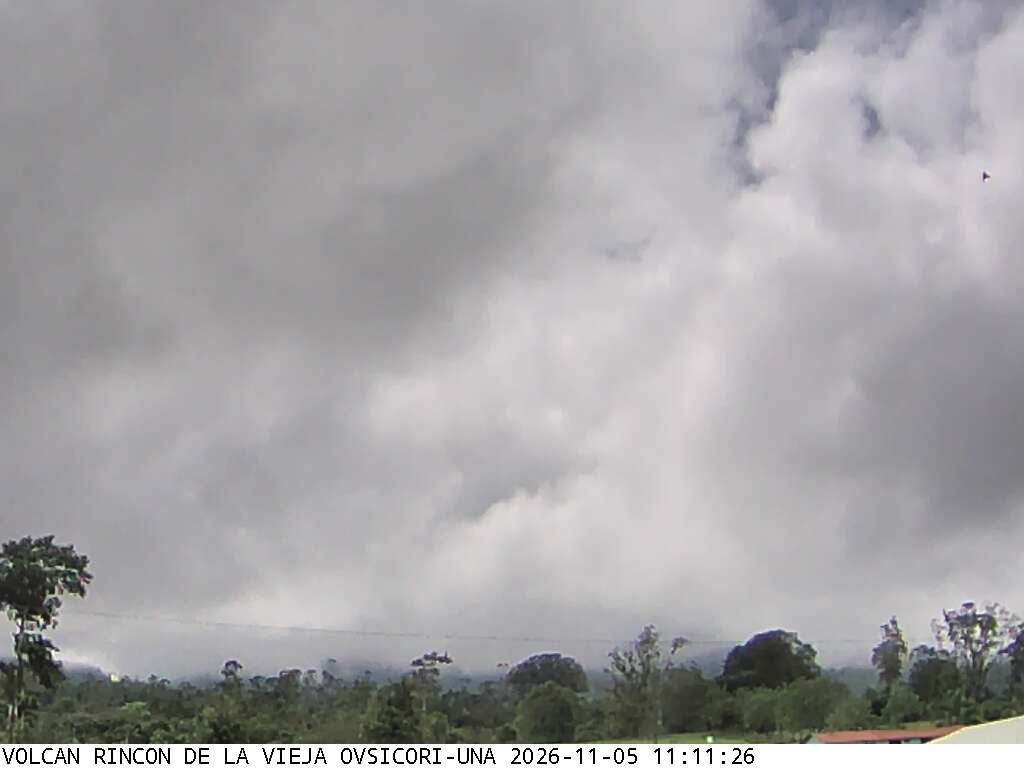
The cams watch the volcano from its northern, western and Caribbean-facing sides. The eruptions are usually phreatic, bursts of steam, water and mud from the crater lake, and can happen at any hour, sometimes throwing material hundreds of metres high.
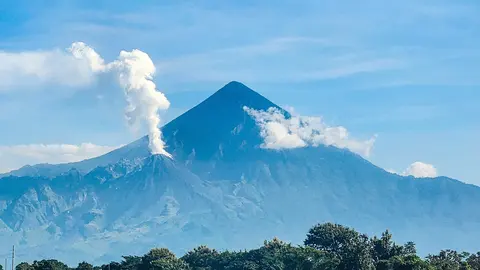
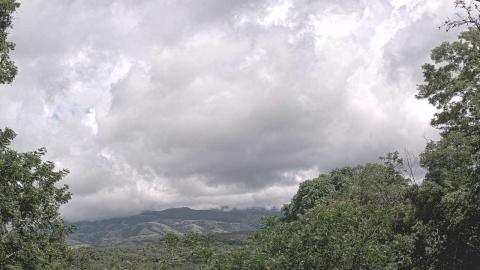
The long ridge of the volcano through a gap in the forest
From Curubandé, on the Pacific side of the volcano, this camera looks at Rincón de la Vieja from a distance, through an opening in the trees. Leafy branches frame the picture on both sides and close in along the bottom. In the gap between them, the land drops to a stretch of forest and then rises to the volcano itself: not a single cone but a long ridge of several summits, its flanks furrowed by ravines. Sky fills most of the frame above the skyline.
Guanacaste has a marked dry season from December to April, when clear skies are the norm and the whole ridge stands out sharply from here.
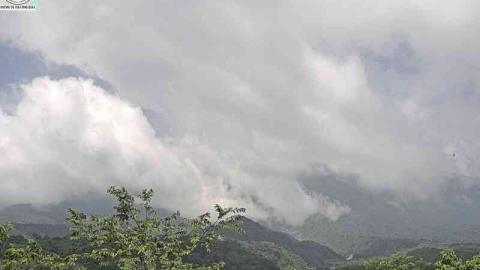
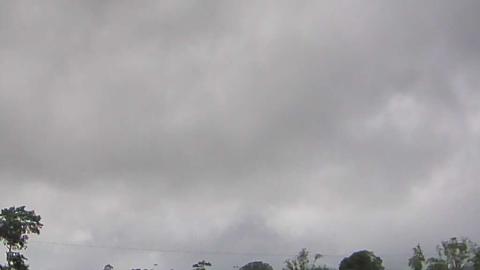
The northern flank above the lowland farms
From Gavilán, in the canton of Upala, this camera looks up at Rincón de la Vieja from the flat country on its northern side. Fields and scattered trees fill the foreground, with a tall tree on the left and the corner of a red roof at the bottom right. Beyond them, the dark base of the volcano runs across the whole width of the picture, and its summits rise on the right into the cloud that often gathers over the ridge.
This is the side where the rivers carry the volcano's lahars, the hot mudflows that its crater eruptions can set off, so the communities along them are the first to be warned when activity rises.
Mudflows
The biggest hazard at Rincón de la Vieja isn’t the eruptions themselves but the lahars they can trigger: hot mud that races down the rivers on the volcano’s northern side. Communities along those rivers are warned when activity rises.
When to watch Rincón de la Vieja
Eruptions can happen at any hour, so the cams are worth checking often. Guanacaste has a marked dry season from December to April, when clear skies are the norm; in the rainy season, mornings are clearest. Costa Rica is six hours behind UTC.
Around Rincón de la Vieja
The foothills around the park are known for hot springs and volcanic mud baths, ziplines and horse riding. Liberia, the capital of Guanacaste, has an international airport, and the beaches of the Pacific coast are about an hour away by road. The dry forests of the region are among the best preserved in Central America.
Visiting Rincón de la Vieja
Rincón de la Vieja National Park, part of the Área de Conservación Guanacaste UNESCO World Heritage site, is about 25 km (16 mi) from Liberia. The trails of the Las Pailas sector pass bubbling mud pots and fumaroles, well away from the active crater, which is closed to visitors.