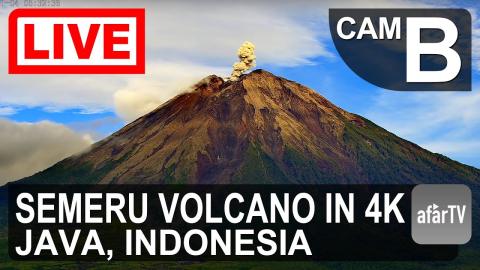
What you can see on the Semeru cams
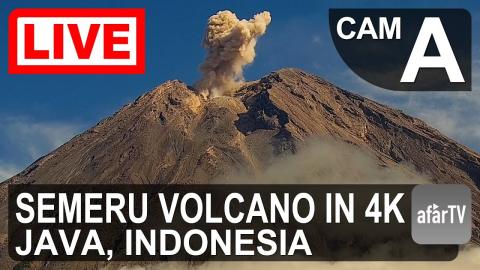
The views take in the bare upper slopes below the summit and one of the river valleys where the volcano's mudflows come down. On many days grey puffs of ash rise from the crater; at night, the glow of lava and incandescent rocks can light up the top of the cone.
The bare grey upper slopes of Semeru
Zoomed in on the upper mountain, this 4K livestream fills the frame with Semeru's bare slopes: steep ridges of grey ash and rock on either side, ribbed with gullies, and between them a wide, sloping valley where loose debris runs down from above. There is no vegetation in sight, only the textures of the volcanic sand and the shadows that move across it as the sun climbs.
Semeru, the highest mountain on Java, has been in eruption almost continuously since 1967, mostly with small explosions from its summit crater, and the ash they leave is what gives these slopes their colour. Clear mornings show the most before cloud gathers on the peak.
Building in the path of Semeru's mudflows
This camera does not look at the summit. It looks down into a broad river valley on the volcano's slopes, filled with grey sand and gravel carried down by Semeru, where a large concrete structure is being built in tiers, with scaffolding and orange formwork along its walls. Trucks and diggers work on the terraces of sand above it, and a track crosses the foreground.
These valleys are where Semeru's lahars, the mudflows of ash and water that follow heavy rain, come down. It shows the other side of living beside the volcano: the work of holding back what it sends down.
Eruptions of Semeru
Semeru’s near-constant small explosions are usually harmless beyond the summit area, but the volcano is also capable of much larger events. On 4 December 2021, part of a lava dome collapsed and sent pyroclastic flows down the Besuk Kobokan valley on the southeast flank, burying villages and killing dozens of people. Badan Geologi keeps a danger zone around the summit and along that valley.
When to watch Semeru
Mornings, especially just after sunrise, are usually the clearest time; clouds tend to build over the summit by late morning. The dry season, roughly from May to October, gives the best chances. Java is seven hours ahead of UTC.
Around Semeru
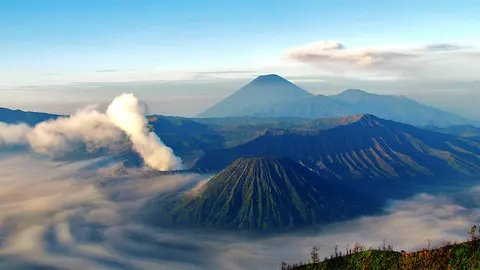
The climbing route from Ranu Pani passes Ranu Kumbolo, a lake at about 2,400 m (7,900 ft) where many hikers camp. In the same national park, the Tengger caldera and the smoking cone of Bromo are among the most visited sights in Indonesia, especially at sunrise from the viewpoints on the caldera rim. The nearest large city is Malang.
Visiting Semeru
Semeru lies in Bromo Tengger Semeru National Park, in East Java. The climbing route from Ranu Pani to the summit closes whenever activity rises; the neighbouring Bromo caldera is the easier and more popular visit.