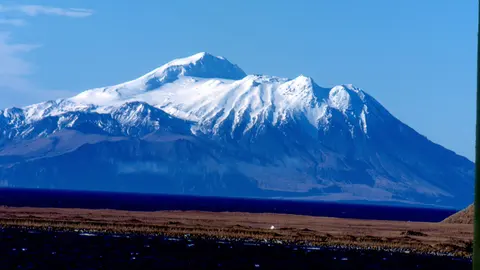
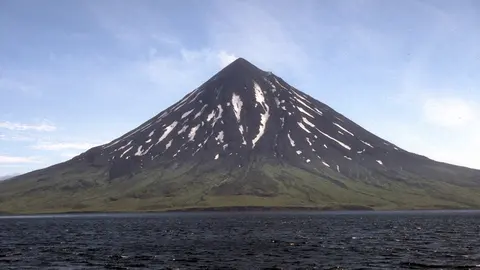
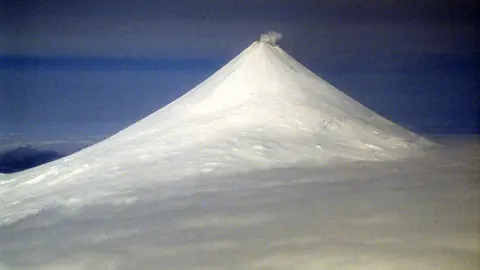
What you can see on the Semisopochnoi cam
The camera is on the caldera floor and looks across it at the young cone in the middle, which is the vent that actually erupts. It is a bleak, treeless landscape of ash and tundra with the caldera wall behind, and it changes with the light and the weather rather than with anything else. Cloud wins most days out here; when it lifts, what the camera shows is a steaming cone with nothing man-made anywhere in frame.
An island with a Russian name and no people
The name is Russian for "having seven hills", from the fur-trade era, and it is a fair description: the caldera rim carries several summits, with Anvil Peak the highest at 1,221 metres. Nobody has ever lived here permanently. The volcano has produced repeated ash emissions in recent decades, and because it is so far out, the observatory relies on satellites and a thin network of instruments to know what it is doing. The whole island belongs to the Alaska Maritime National Wildlife Refuge and is important for seabirds.
When to watch Semisopochnoi
The western Aleutians keep Hawaii-Aleutian time, ten hours behind UTC in winter and nine in summer, so the island is in daylight through the European night and the American small hours. The weather is the real constraint rather than the hour: this is one of the cloudiest, windiest places anywhere, and a clear frame is worth waiting for.
Around Semisopochnoi
The nearest inhabited place is Adak, about 250 kilometres east, a former naval station with a few hundred residents. Between them lie the Rat Islands, including Kiska and Little Sitkin, all uninhabited and all volcanic.
Visiting Semisopochnoi
There is no way to visit in any ordinary sense: no airstrip, no harbour, no shelter, and weather that closes in without warning. The people who land here are researchers and refuge staff, brought by ship and usually for a few hours.