Nature Live Cams

Turrialba Volcano live cam

No recent report Stratovolcano in Cartago, Costa Rica

Live image of Turrialba Volcano: Active crater

Active crater

Source: OVSICORI-UNA

Pointed at the active crater of Turrialba, from the observatory’s monitoring station. What you see

Turrialba, 3,340 m (10,958 ft) high, is the easternmost volcano of Costa Rica’s Central Volcanic Range. After more than a century of calm, it woke up in 2010 and was one of the country’s most active volcanoes for the next decade.

Turrialba Volcano right now

Activity

No recent report

No automatic alert feed for this volcano. The observatory links below carry the latest reports.

Local time

–

Sunset at 5:10 pm, in 3 h 54 min.

Clouds over the summit

Overcast

99% cloud cover.

At the summit

9 °C (49 °F)

Wind 12 km/h (7 mph) from the NW.

Forecast model values for the summit area from MET Norway, updated 19:02 UTC. Not a measurement.

Is Turrialba Volcano erupting right now?

No eruption reported. Nothing has been reported for it in recent weekly volcanic activity reports from the Smithsonian and USGS. Checked November 5, 19:02 UTC.

Earthquakes near Turrialba Volcano

0 in the last 24 hours, 0 in the last 7 days and 2 in the last 30 days, within 30 km (19 mi) of the summit. The largest was magnitude 2.8 on October 6.

Oct 7: 1Oct 8: 0Oct 9: 0Oct 10: 0Oct 11: 1Oct 12: 0Oct 13: 0Oct 14: 0Oct 15: 0Oct 16: 0Oct 17: 0Oct 18: 0Oct 19: 0Oct 20: 0Oct 21: 0Oct 22: 0Oct 23: 0Oct 24: 0Oct 25: 0Oct 26: 0Oct 27: 0Oct 28: 0Oct 29: 0Oct 30: 0Oct 31: 0Nov 1: 0Nov 2: 0Nov 3: 0Nov 4: 0Nov 5: 030 days agoToday
Earthquakes per day. Busiest day: 1.
When (UTC)MagnitudeDepthDistance
Oct 11, 06:132.510 km5 km
Oct 6, 22:122.88 km20 km

Source: EMSC. Updated November 5, 19:02 UTC. EMSC combines the catalogues of national seismic networks, but it mostly lists earthquakes large enough to be reported internationally; many small volcanic earthquakes are not included. Small earthquakes are common under active volcanoes and do not by themselves mean an eruption is coming.

What you can see on the Turrialba cams

The cam is pointed at Turrialba’s active crater. On most days it shows a plume of steam and gas; after heavy rain the plume can grow, and ash emissions show up as a grey or brown cloud.

Banded crater walls and the steaming vent

The camera stands on the edge of Turrialba's summit and looks across the crater from the side. On the left, a grassy ridge with a wooden fence runs up to a small hut and a mast; in the middle, steam pours up from the active vent, deep inside the crater; and on the right the far wall rises in bands of ochre, yellow and grey, the layers of old eruptions laid bare. Below it, the crater floor is covered in dark ash with a few pale patches.

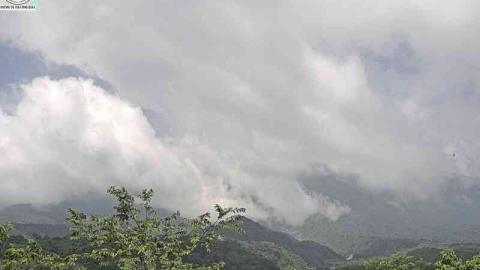
Mornings are the clearest time to look: cloud often covers the summit by midday, and the steam from the vent then merges into it.

Eruptions of Turrialba

Turrialba’s previous eruption ended in 1866. Gas emissions increased from the 1990s, and in 2010 a new vent opened. From 2014 onwards, explosions sent ash over the Central Valley, sometimes forcing the international airport in San José to close for hours. Activity declined after 2020, but OVSICORI continues to watch the volcano closely.

When to watch Turrialba

Mornings are clearest, as clouds often cover the summit by midday. The Caribbean-facing slopes where Turrialba stands get rain in most months, so clear views are worth catching when they come. Costa Rica is six hours behind UTC.

Around Turrialba

The town of Turrialba, below the volcano, is a base for white-water rafting on the Pacuare and Reventazón rivers. Nearby, Guayabo National Monument protects the largest archaeological site in Costa Rica, with stone roads, mounds and aqueducts built by its pre-Columbian inhabitants. The CATIE research centre has a botanical garden open to visitors.

Visiting Turrialba

Turrialba Volcano National Park lies about 70 km (45 mi) by road from San José. It was closed for years during the eruptions; access to the summit area depends on the volcano’s activity, so check the national park service (SINAC) before going.
Volcano cams near Turrialba Volcano

Turrialba Volcano on the map

More volcano cams in Mexico & Central America