What you can see on the Eyjafjallajökull cams
The live video looks at the volcano from the lowlands of South Iceland. On clear days the white dome of the ice cap stands out above green farmland and steep cliffs; in winter snow reaches down to the foot of the mountain, and the weather can change within minutes.
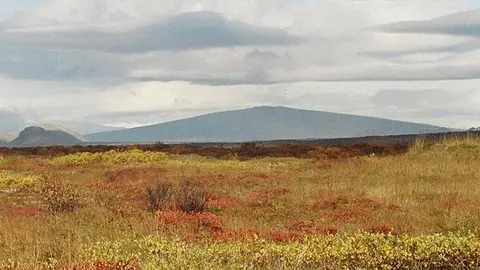
A road across the moorland of South Iceland
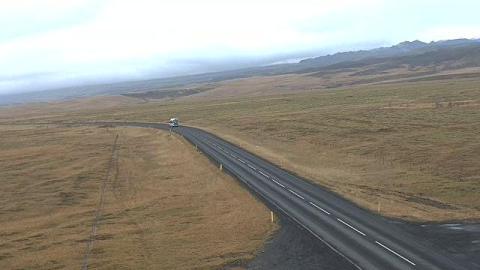
This road-weather camera, labelled Péturey on the picture, looks west along a road in South Iceland. The tarmac comes in at the lower right and curves away across a broad plain of brown moorland, with roadside marker posts, a fence line and pools of standing water in the grass. Low, smooth hills rise on the right towards a higher ridge in the distance, while the plain runs out to the horizon on the left.
It is a still image, refreshed at intervals, with the time and date printed along the bottom. On clear days the ice cap of Eyjafjallajökull can appear in the distance; when cloud hides it, the picture is still a quick check of the weather on this stretch of the south.
The 2010 eruption
After weeks of earthquakes, a fissure opened on the Fimmvörðuháls pass in March 2010 and produced a small lava eruption that drew crowds of visitors. In April the eruption moved to the summit crater under the ice, where meltwater made it explosive and shattered the magma into fine ash. Winds carried the ash towards Europe, and over several days about 100,000 flights were cancelled. The volcano’s previous eruption had lasted from 1821 to 1823.
When to watch Eyjafjallajökull
Clear mornings and evenings give the best light on the ice cap, and winter often brings the sharpest air. Iceland is on UTC all year.
Around Eyjafjallajökull
Two of Iceland’s best-known waterfalls lie at the foot of the mountain, next to the ring road: Seljalandsfoss, which you can walk behind, and Skógafoss. The Fimmvörðuháls trail crosses the pass between Eyjafjallajökull and Mýrdalsjökull, past the craters of 2010, and descends into the valley of Þórsmörk.
Visiting Eyjafjallajökull
The Fimmvörðuháls trail is a long day hike from Skógar to Þórsmörk, normally possible only in summer. Weather in the mountains changes fast, so check the forecast and trail conditions before going.