What you can see on the Mount Pico cams
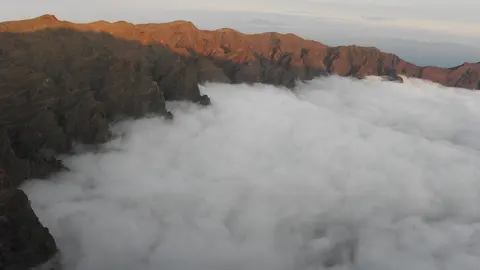
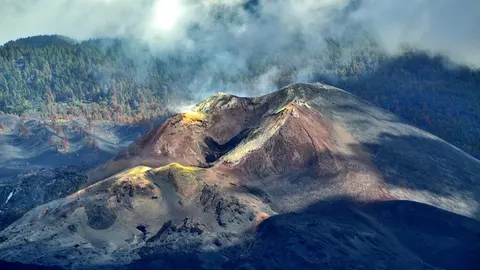
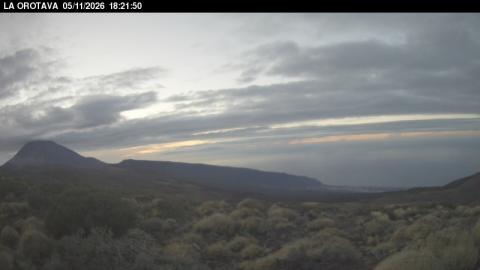
The cameras cover the mountain from two sides. From the north coast the cone appears almost as a textbook silhouette, filling the frame from the shoreline to the summit, so it is easy to follow the cloud cap that forms and dissolves over the top through the day. From the south the view is lower and wider: the harbour of Lajes do Pico with its fishing boats, the channel towards São Jorge, and the mountain rising behind the village roofs. Mornings often show the lenticular cloud that sits on the summit; by afternoon the cone can disappear completely into cloud and reappear within minutes.
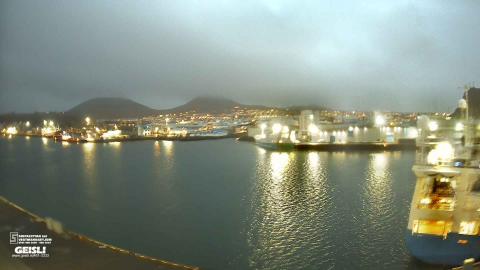
The harbour of Lajes do Pico
From a whale-watching station above the harbour of Lajes do Pico, on the island's south coast, the camera looks out over red-tiled roofs to the breakwater, the boats moored inside it and the open Atlantic beyond. The mountain itself appears on the right when the cloud lifts, which on many days it does not. This is live video, not a still image.
It is the cam that shows the sea: the swell at the harbour mouth and, in the season, the whale-watching boats that sail from here.
A volcano still counted as active
Pico last erupted in 1720, from fissures on its flanks rather than at the summit. Those eruptions left the dark lava fields that run down to the coast, and it is on those fields that islanders built the currais: thousands of small walled enclosures of lava stone, each sheltering a few vines from the salt wind. The vineyard landscape they form is a UNESCO World Heritage site, and the whole archipelago is a UNESCO Global Geopark.
When to watch Mount Pico
The Azores are on UTC−1 in winter and UTC+0 from late March to late October, so local time is close to London's. The cone is clearest early, before the day's cloud builds, and again in the last hour of light. Winter brings snow to the summit and the sharpest air; summer is warmer but hazier.
Around Mount Pico
Lajes do Pico, below one of the cameras, was a whaling port and is now one of the best places in Europe for whale and dolphin watching, with sperm whales offshore most of the year. São Roque, on the north coast, has the old whaling factory, kept as a museum. The island's lava tubes, notably Gruta das Torres, run for kilometres underground.
Visiting Mount Pico
The climb starts at Casa da Montanha at 1,231 metres. Walkers register there, carry a tracker and are limited in number each day; the round trip takes most people six to eight hours. Weather on the mountain changes fast, and the route closes when conditions are poor.