Nature Live Cams

Caldera de Taburiente and Roque de los Muchachos live cams

No recent report Erosion caldera in Canary Islands (La Palma), Spain

This stream is off air right now

The owner’s stream pauses from time to time and usually comes back within a few hours. Meanwhile, these views of Caldera de Taburiente are live:

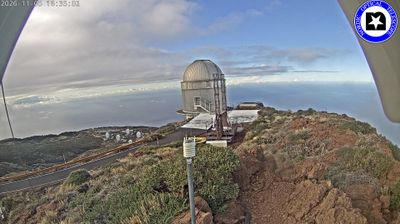
Roque de los Muchachos observatory Telescopes on the rim Try this one anyway

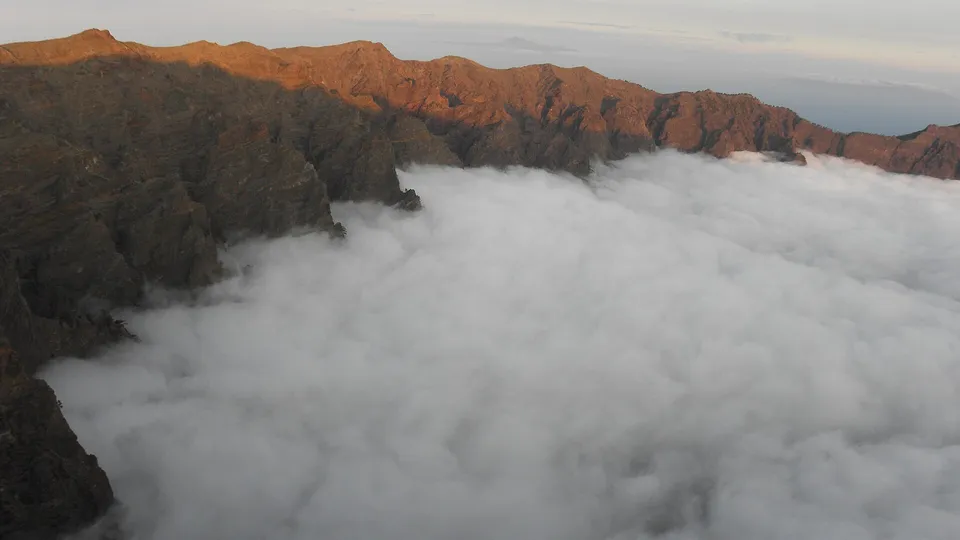
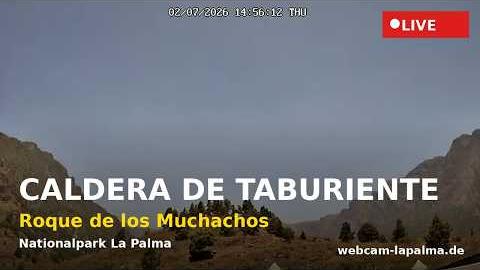
The caldera from El Paso

Source: webcam-lapalma.de

From El Paso, in the valley south of the caldera, looking north to its cliff walls and ridges, in Full HD.

The Caldera de Taburiente is a huge circular basin in the north of La Palma, in the Canary Islands, about 8 km (5 mi) wide and with walls up to 2,000 m (6,600 ft) high. Its rim reaches 2,426 m (7,959 ft) at Roque de los Muchachos, the highest point on the island.

Caldera de Taburiente right now

Activity

No recent report

No automatic alert feed for this volcano. The observatory links below carry the latest reports.

Local time

–

Sunset at 6:23 pm, in 1 h 26 min.

Clouds over the summit

Mostly clear

18% cloud cover.

At the summit

9 °C (49 °F)

Wind 25 km/h (16 mph) from the SW.

Forecast model values for the summit area from MET Norway, updated 16:32 UTC. Not a measurement.

Is Caldera de Taburiente erupting right now?

No eruption reported. Nothing has been reported for it in recent weekly volcanic activity reports from the Smithsonian and USGS. Checked November 5, 16:32 UTC.

Earthquakes near Caldera de Taburiente

0 in the last 24 hours, 0 in the last 7 days and 5 in the last 30 days, within 30 km (19 mi) of the summit. The largest was magnitude 1.9 on October 7.

Oct 7: 0Oct 8: 5Oct 9: 0Oct 10: 0Oct 11: 0Oct 12: 0Oct 13: 0Oct 14: 0Oct 15: 0Oct 16: 0Oct 17: 0Oct 18: 0Oct 19: 0Oct 20: 0Oct 21: 0Oct 22: 0Oct 23: 0Oct 24: 0Oct 25: 0Oct 26: 0Oct 27: 0Oct 28: 0Oct 29: 0Oct 30: 0Oct 31: 0Nov 1: 0Nov 2: 0Nov 3: 0Nov 4: 0Nov 5: 030 days agoToday
Earthquakes per day. Busiest day: 5.
When (UTC)MagnitudeDepthDistance
Oct 8, 02:041.79 km21 km
Oct 7, 23:531.74 km11 km
Oct 7, 23:131.717 km23 km
Oct 7, 21:261.924 km26 km
Oct 7, 21:101.618 km21 km

Source: EMSC. Updated November 5, 15:02 UTC. EMSC combines the catalogues of national seismic networks, but it mostly lists earthquakes large enough to be reported internationally; many small volcanic earthquakes are not included. Small earthquakes are common under active volcanoes and do not by themselves mean an eruption is coming.

What you can see on the Caldera de Taburiente cams

The livestreams look at the caldera from the valley of El Paso, to the south, and across the observatory on Roque de los Muchachos, on its rim. Very often the caldera fills with clouds that spill over the rim like a slow waterfall, while the summit stays in bright sunshine. At night the domes of the telescopes stand under one of the darkest skies in Europe.

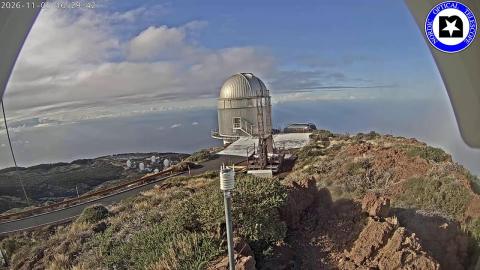
Telescope domes on the summit of La Palma

From the summit ridge of La Palma, at about 2,400 m, this fisheye camera looks out over the Roque de los Muchachos Observatory. A silver telescope dome stands on its white platform in the middle of the picture, with a weather mast in front and the summit road curving past below. Further off, on the flat ground of the ridge, the white domes of other telescopes catch the sun, and beyond them the horizon is sea.

On many days the clouds sit well below the camera, a sea of cloud that is one of the reasons the telescopes were built up here.

How it formed

Despite its name, the caldera was not made by a single volcanic collapse. It formed on an old volcano that partly slid into the sea in a giant landslide, and was then widened by erosion over hundreds of thousands of years. Streams still run through its floor all year, a rarity in the Canary Islands, and have cut the deep Barranco de las Angustias, the only way out of the caldera. The word “caldera”, now used by volcanologists everywhere, comes from here.

When to watch Caldera de Taburiente

The sea of clouds is most frequent when the trade winds blow, especially in summer. Clear nights around the new moon are best for the stars. The Canary Islands follow Western European Time: UTC in winter and one hour ahead in summer.

Around the caldera

The Roque de los Muchachos Observatory hosts telescopes from many countries, including the Gran Telescopio Canarias, one of the largest optical telescopes in the world. La Palma was the first Starlight Reserve, and a law protects its night sky from light pollution.

Visiting Caldera de Taburiente

The national park has trails from the viewpoint of La Cumbrecita and down to the floor of the caldera, where camping requires a permit. At busy times, driving up to La Cumbrecita may need a booking.
Volcano cams near Caldera de Taburiente

Caldera de Taburiente on the map

More volcano cams in Spain