What you can see on the Caldera de Taburiente cams
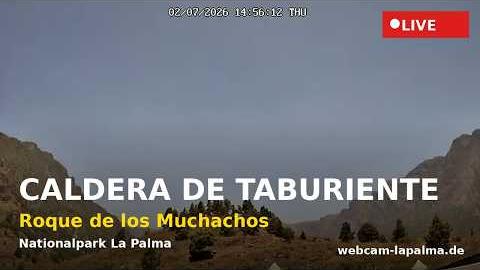
The livestreams look at the caldera from the valley of El Paso, to the south, and across the observatory on Roque de los Muchachos, on its rim. Very often the caldera fills with clouds that spill over the rim like a slow waterfall, while the summit stays in bright sunshine. At night the domes of the telescopes stand under one of the darkest skies in Europe.
Telescope domes on the summit of La Palma
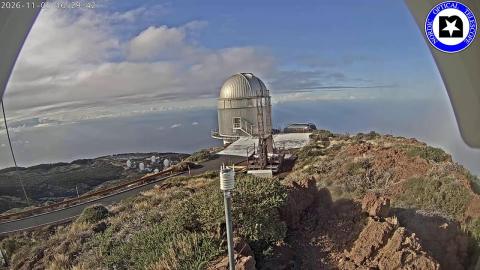
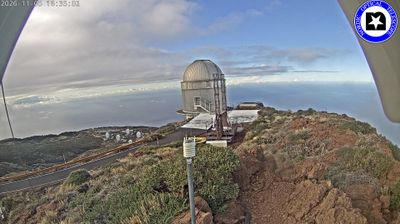
From the summit ridge of La Palma, at about 2,400 m, this fisheye camera looks out over the Roque de los Muchachos Observatory. A silver telescope dome stands on its white platform in the middle of the picture, with a weather mast in front and the summit road curving past below. Further off, on the flat ground of the ridge, the white domes of other telescopes catch the sun, and beyond them the horizon is sea.
On many days the clouds sit well below the camera, a sea of cloud that is one of the reasons the telescopes were built up here.
How it formed
Despite its name, the caldera was not made by a single volcanic collapse. It formed on an old volcano that partly slid into the sea in a giant landslide, and was then widened by erosion over hundreds of thousands of years. Streams still run through its floor all year, a rarity in the Canary Islands, and have cut the deep Barranco de las Angustias, the only way out of the caldera. The word “caldera”, now used by volcanologists everywhere, comes from here.
When to watch Caldera de Taburiente
The sea of clouds is most frequent when the trade winds blow, especially in summer. Clear nights around the new moon are best for the stars. The Canary Islands follow Western European Time: UTC in winter and one hour ahead in summer.
Around the caldera
The Roque de los Muchachos Observatory hosts telescopes from many countries, including the Gran Telescopio Canarias, one of the largest optical telescopes in the world. La Palma was the first Starlight Reserve, and a law protects its night sky from light pollution.
Visiting Caldera de Taburiente
The national park has trails from the viewpoint of La Cumbrecita and down to the floor of the caldera, where camping requires a permit. At busy times, driving up to La Cumbrecita may need a booking.