What you can see on the Akita-Yakeyama cam
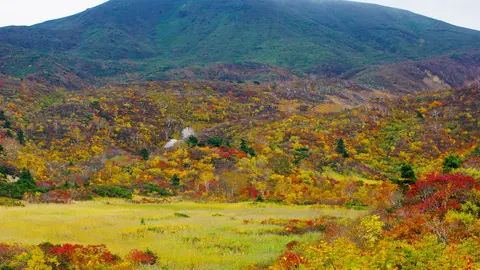
Akita-Yakeyama is a volcano for watching the ground itself: pale rock bleached by heat and gas, with steam rising from vents near the summit. The slopes around it are green in summer, take on autumn colour in early October and lie under snow from about November to May. It is a quiet volcano to watch, and the interest lies in how light and cold change the steam rather than in anything dramatic happening.
Pale, steaming ground in the crater
From a grassy slope above the crater, the camera looks across to the bare heart of the volcano. Low green and brown vegetation covers the near ground. Beyond it the land dips into the crater, where a stretch of pale, bleached rock lies below a rounded ridge, and steam from the vents along one side drifts low across the slope to the right. A distant mountain shows faintly on the horizon behind.
The pale ground is rock altered by heat and volcanic gas. The steam stands out most on cold, still mornings, and from about November to May the crater is under snow.
Steam without lava
Akita-Yakeyama's recent history is of small steam-driven explosions rather than eruptions of magma. The most recent was in 1997, and it killed three people who were at a hot spring on the flank when gas collected in a hollow — a reminder that on this kind of volcano the danger is often invisible. The surrounding area has some of the strongest geothermal activity in Japan, and the hot springs below the mountain are among the most sought after in the country.
When to watch Akita-Yakeyama
Japan is nine hours ahead of UTC all year. The crater is under snow from about November to May, and the steam stands out most on cold, still mornings. Summer and early autumn show the ground itself, and the autumn colour on the lower slopes arrives in the first half of October.
Around Akita-Yakeyama
Goshogake Onsen sits on the northern flank and has a walk through a field of mud pots and steam vents. Tamagawa Onsen, on the other side, produces the most acidic hot spring water in Japan and the largest flow from a single source; people go there for weeks at a time. Lake Towada and the Hachimantai plateau are part of the same national park.
Visiting Akita-Yakeyama
The climb from Goshogake or from the Yakeyama trailhead takes two to three hours and is not technical, but parts of the route are closed when gas levels rise, and that happens without warning. Snow closes the approach roads through the winter.