What you can see on the Mount Meakan cams
Meakan is a volcano to watch for its plume: white steam rising behind the crater rim, above slopes of bare grey and ochre ash. Seen from afar, it shows where the steam sits among the summits of the range; up close, how it changes from hour to hour and with the air temperature. The low morning sun picks out the ridges best, and the colour of the ground shifts from grey to ochre with the light.
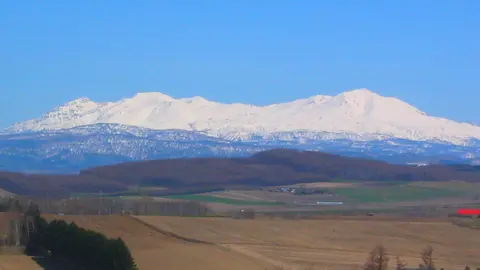
The Meakan range and its plume from the lowland
This is the long view: across forest and scrub in the foreground to the whole Meakan range on the skyline. Several summits line up from left to right, with dark peaks on the left, a broad, pale summit in the middle and a long ridge running off to the right. When the vents are steaming, the plume rises from the left-hand part of the range, small at this distance but easy to pick out against the sky.
It is the camera for seeing the plume and the weather on the whole range at once, and for where the steam sits in relation to the other summits, which the close-up camera at the crater cannot show. The low morning sun picks out the ridges best.
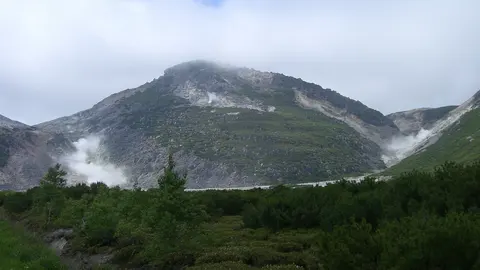
Bare ash slopes at the summit craters
Up at the summit, the camera looks across bare, rough ground towards the crater rim. On the left a slope of grey and ochre ash climbs steeply, marked with paler bands; low shrubs creep over the stony ground in the foreground and on the right, and the rim runs as an almost level line across the middle of the frame. When the craters are steaming, the plume rises white behind the rim.
Close up like this, the camera shows how the steam changes from hour to hour and how the colour of the ground shifts from grey to ochre with the light. Meakan is closely watched because its alert level moves up and down, closing the summit path when it rises.
Marimo, and a volcano that keeps clearing its throat
Lake Akan, below the volcano, is the only place in Japan where marimo grow in quantity — velvet-green balls of algae, rolled smooth by the currents, that can take decades to reach the size of an apple. They are a protected natural monument and the reason most visitors come. The volcano above them is less gentle: Meakan produced ash emissions in 2006 and again in 2008, and its alert level moves up and down, closing the summit path when it does.
When to watch Mount Meakan
Japan is nine hours ahead of UTC all year. June to October is the clear season; from November the range is under snow and cloud for long stretches. Early morning is the most reliable hour, and it is also when the steam stands out most against the cold air.
Around Mount Meakan
Akanko Onsen, on the lakeshore, is the base: a hot spring town with an Ainu kotan, a village of craft workshops and a theatre. Lake Mashū, one of the clearest lakes in the world, and the sulphur mountain of Atosanupuri are both within an hour.
Visiting Mount Meakan
The climb from Akan Kohan or from Onneyu takes about three hours up, on ash and loose rock, and ends at the crater rim with the lakes below. Access is closed when the alert level rises, which is worth checking before setting out.