Nature Live Cams

Mount Nikkō-Shirane live cams

No recent report Shield volcano in Tochigi, Japan

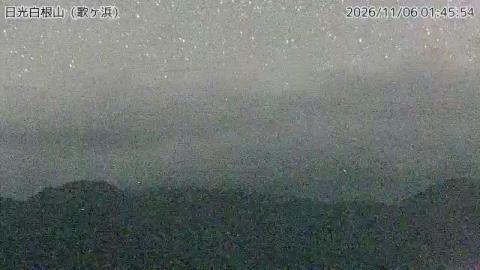
Live image of Mount Nikkō-Shirane: Utagahama, Lake Chūzenji

Utagahama, Lake Chūzenji

Source: Japan Meteorological Agency (JMA)

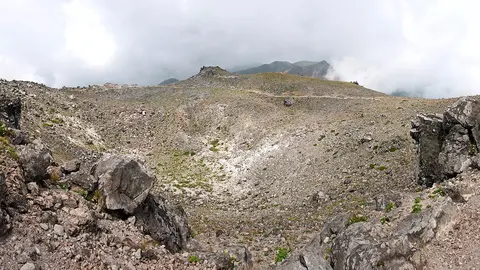
From Utagahama, by Lake Chūzenji: the rocky summit of Nikkō-Shirane above its ridge. What you see

Mount Nikkō-Shirane is a group of four lava domes sitting on top of an older shield volcano, on the border of Tochigi and Gunma. At 2,578 m (8,458 ft) it is the highest mountain anywhere north of Tokyo, and it closes the western end of the Nikko highlands.

Mount Nikkō-Shirane right now

Activity

No recent report

No automatic alert feed for this volcano. The observatory links below carry the latest reports.

Local time

–

Sunrise at 6:10 am, in 4 h 40 min.

Clouds over the summit

Mostly clear

26% cloud cover.

At the summit

1 °C (33 °F)

Wind 10 km/h (6 mph) from the W.

Forecast model values for the summit area from MET Norway, updated 16:02 UTC. Not a measurement.

Is Mount Nikkō-Shirane erupting right now?

No eruption reported. Nothing has been reported for it in recent weekly volcanic activity reports from the Smithsonian and USGS. Checked November 5, 16:02 UTC.

When did Mount Nikkō-Shirane last erupt?

Last eruption: 1952.

Earthquakes near Mount Nikkō-Shirane

No earthquakes large enough to appear in the international catalogue have been recorded within 30 km (19 mi) of the summit in the last 30 days.

Source: EMSC. Updated November 5, 14:32 UTC. EMSC combines the catalogues of national seismic networks, but it mostly lists earthquakes large enough to be reported internationally; many small volcanic earthquakes are not included. Small earthquakes are common under active volcanoes and do not by themselves mean an eruption is coming.

What you can see on the Nikkō-Shirane cams

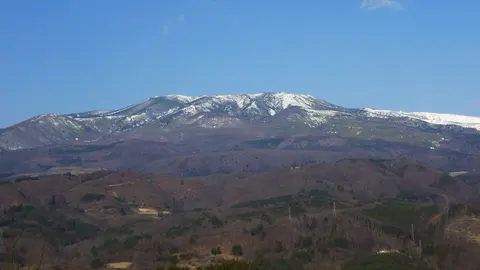
Nikkō-Shirane shows as a broad summit dome with a rocky crown, standing above lower, rounded ridges as the highest point of the skyline. Its look changes with the light, from a soft blue-grey shape in haze to a sharp, rocky top in clear sun. Snow lies on the upper slopes from November into May, and October brings red and gold to the trees below.

The rocky summit in the morning sun

This camera at Utagahama, on Lake Chūzenji, looks across to the ridge of Nikkō-Shirane, which runs along the bottom of the frame below a wide sky. The summit stands just left of centre, a squat, rocky top higher than the rest, with lower, rounded peaks on either side. Morning light warms the upper slopes while the nearer ridges stay in shade. The lake itself is out of the picture.

From here the summit shows its rocky crown more clearly than from Kamikogawa, where it is a softer shape in the haze. The last eruption, a steam explosion from the youngest dome, was in 1952.

A lone summit at the head of a narrow valley

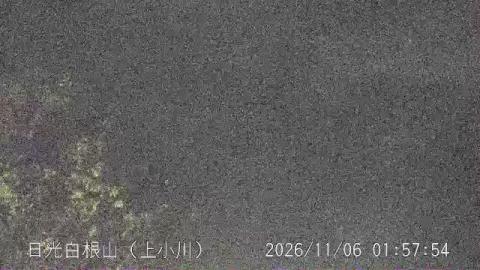
From Kamikogawa, the camera looks up a steep-sided valley to the summit of Nikkō-Shirane, framed between a tree on the left and the dark valley wall on the right. The peak rises as a broad, rounded dome above lower, hazy ridges, and power lines cross the upper part of the sky. In the morning the mountain stands against the light as a blue-grey shape; the slopes are lit later in the day.

At 2,578 m, Nikkō-Shirane is the highest peak in Japan from the Kantō region northwards. Snow lies on the upper slopes from November into May, and the tree in front turns red and gold in October.

A volcano that made the lakes

The scenery around Nikkō was arranged by this volcano. Thick, slow lava flows from Keizukayama, the shield underneath the domes, came down and dammed the valleys to the north, creating Lake Yunoko and the Senjōgahara marsh. Lake Chūzenji itself was formed when Nantaisan, the neighbouring volcano, blocked the Daiya river; the water escapes over Kegon Falls, a 97 m drop that is one of the best known waterfalls in Japan. Every eruption recorded at Shiranesan between the seventeenth and twentieth centuries was a steam explosion from the youngest dome, the last in 1952. A mountain flower, the shirane-aoi, is named after the peak.

When to watch Nikkō-Shirane

Mid-October is the peak of the autumn colour around the lake, and the busiest time on the roads. Winter mornings are the clearest. Japan is nine hours ahead of UTC.

Around Nikkō-Shirane

Nikko National Park holds the Tōshō-gū shrine complex, the Irohazaka hairpin road up to the lake, and the Yumoto hot springs at the far end of the valley. Marunuma Kōgen, on the Gunma side, has a ropeway and a ski area.

Visiting Nikkō-Shirane

The ropeway from Marunuma leaves walkers about two hours below the summit. From the Tochigi side the route starts at Yumoto and is longer. Both are snowbound in winter.
Volcano cams near Mount Nikkō-Shirane

Mount Nikkō-Shirane on the map

Mount Aso, Kumamoto, JapanAsoMount Fuji, Shizuoka and Yamanashi, JapanFujiMount Asama, Nagano and Gunma, JapanAsamaKirishima (Shinmoedake), Kagoshima and Miyazaki, JapanKirishimaKusatsu-Shirane, Gunma, JapanKusatsu-ShiraneMount Unzen, Nagasaki, JapanUnzenMount Tokachi, Hokkaido, JapanTokachiMount Iwate, Iwate, JapanIwateMount Hakkōda, Aomori, JapanHakkōdaMount Adatara, Fukushima, JapanAdataraMount Komagatake, Hokkaido, JapanKomagatakeMount Esan, Hokkaido, JapanEsanMount Zaō, Yamagata and Miyagi, JapanZaōMount Usu, Hokkaido, JapanUsuMount Bandai, Fukushima, JapanBandaiTaisetsuzan, Hokkaido, JapanTaisetsuzanKuttara, Hokkaido, JapanKuttaraAogashima, Izu Islands, Tokyo, JapanAogashimaMount Meakan, Hokkaido, JapanMeakanSatsuma-Iōjima, Kagoshima, JapanSatsuma-IōjimaAkita-Yakeyama, Akita, JapanAkita-YakeyamaAtosanupuri, Hokkaido, JapanAtosanupuriMount Chōkai, Akita and Yamagata, JapanChōkaiHachijōjima, Izu Islands, Tokyo, JapanHachijōjimaKuchinoerabujima, Kagoshima, JapanKuchinoerabujimaMount Kurikoma, Iwate, Miyagi and Akita, JapanKurikomaNakanoshima, Tokara Islands, Kagoshima, JapanNakanoshimaMount Nasu, Tochigi, JapanNasuMount Azuma, Fukushima, JapanAzumaMount Hakone, Kanagawa, JapanHakoneMount Haku, Ishikawa, JapanHakuMount Iwaki, Aomori, JapanIwakiIzu Ōshima, Tokyo, JapanIzu ŌshimaIzu-Tōbu, Shizuoka, JapanIzu-TōbuKōzushima, Tokyo, JapanKōzushimaMount Kujū, Oita, JapanKujūNiigata-Yakeyama, Niigata, JapanNiigata-YakeyamaNiijima, Tokyo, JapanNiijimaMount Nikkō-Shirane, Tochigi, JapanNikkō-ShiraneMount Norikura, Nagano, JapanNorikuraMount Ontake, Nagano, JapanOntakeMount Tarumae, Hokkaido, JapanTarumaeLake Towada, Aomori, JapanLake TowadaMount Tsurumi, Oita, JapanTsurumiSakurajima, Kagoshima, JapanSakurajimaSuwanosejima, Kagoshima (Tokara Islands), JapanSuwanosejima

More volcano cams in Japan