Nature Live Cams

Mount Hakone live cams

No recent report Caldera complex in Kanagawa, Japan

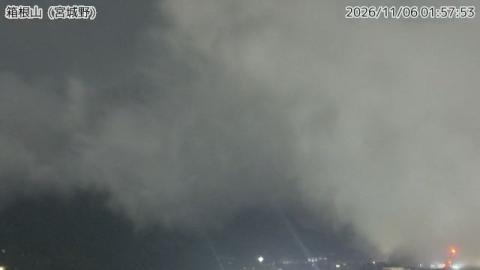
Live image of Mount Hakone: Ōwakudani vents

Ōwakudani vents

Source: Japan Meteorological Agency (JMA)

Pointed straight at the Ōwakudani vents, close enough to show the steam leaving the hillside. What you see

Hakone is a volcano with a town inside it. Two overlapping calderas, the larger one 10 by 11 km across, hold hot spring resorts, a lake and a cluster of lava domes, and the whole bowl sits an hour and a half from Tokyo. The high point, Kamiyama, reaches 1,438 m (4,718 ft).

Mount Hakone right now

Activity

No recent report

No automatic alert feed for this volcano. The observatory links below carry the latest reports.

Local time

–

Sunrise at 6:09 am, in 4 h 39 min.

Clouds over the summit

Mostly cloudy

86% cloud cover. Clearest in the next 24 hours: around 10:00 am (4%).

At the summit

9 °C (48 °F)

Wind 17 km/h (11 mph) from the SW.

Forecast model values for the summit area from MET Norway, updated 16:02 UTC. Not a measurement.

Is Mount Hakone erupting right now?

No eruption reported. Nothing has been reported for it in recent weekly volcanic activity reports from the Smithsonian and USGS. Checked November 5, 16:02 UTC.

When did Mount Hakone last erupt?

Last eruption: 2015, at Ōwakudani.

Earthquakes near Mount Hakone

No earthquakes large enough to appear in the international catalogue have been recorded within 30 km (19 mi) of the summit in the last 30 days.

Source: EMSC. Updated November 5, 13:02 UTC. EMSC combines the catalogues of national seismic networks, but it mostly lists earthquakes large enough to be reported internationally; many small volcanic earthquakes are not included. Small earthquakes are common under active volcanoes and do not by themselves mean an eruption is coming.

What you can see on the Hakone cams

Hakone is a forested caldera with hot spring villages inside it, and its liveliest sight is Ōwakudani, where thick white steam pours out of a bare, grey hillside without pause. Cold, still mornings give the thickest plumes, sometimes enough to hide the slope behind them. Mornings and winter days are also the clearest for the wooded peaks of the caldera.

Steam pouring from the Ōwakudani hillside

Pointed straight at Ōwakudani, this camera is close enough to watch the steam leave the ground. Thick white plumes rise from vents across the bare, grey slope and drift up the hillside, often hiding part of it, while smaller jets show further to the left. On the right, stepped concrete walls built into the slope reach the edge of the frame, and dry grass and bare shrubs fill the foreground.

Ōwakudani formed about 3,000 years ago, when a steam explosion brought down part of Kamiyama. Cold, still mornings give the thickest plumes, and the paths near the vents open and close with the gas readings.

Wooded peaks of the caldera from the valley floor

From Miyagino, down in the valley, the view climbs to a pair of wooded summits with a pale gash of bare ground in the hollow between them. Forest runs almost unbroken across the slopes, from the lower ridges on the left to a rockier spur on the right, and a few buildings show at the foot of the frame. The caption reads Hakone-yama (Miyagino).

This is the quieter of the two Hakone cameras: where the Ōwakudani view shows the vents up close, this one shows the setting, the forested inside of a volcano with hot spring villages in it. Mornings and winter days are usually the clearest.

Ōwakudani, the great boiling valley

Ōwakudani opened about 3,000 years ago, when a steam explosion brought down part of Kamiyama's northwest side. What is left is a hillside of sulphur, fumaroles and hot springs that has been a sightseeing stop for more than a century. Eggs boiled in the sulphurous pools come out with black shells and are sold as kuro-tamago; local tradition says one adds seven years to your life. In 2015 a small steam eruption threw ash over the valley, and the area was closed for months while the vents settled. Everything recorded here in modern times has been of that kind: steam and ash, never lava.

When to watch Hakone

Cold, still mornings give the thickest plume, so winter is the best season for the Ōwakudani view. Hakone is also famous for days when Mount Fuji appears behind Lake Ashi, and those come most often from December to February. Japan is nine hours ahead of UTC.

Around Hakone

Lake Ashi fills the southwest corner of the caldera, with the red torii of Hakone Shrine standing in the water. The old Tōkaidō road and its checkpoint, the open-air sculpture museum and dozens of hot spring inns are all within the same bowl.

Visiting Hakone

The ropeway crosses directly over Ōwakudani, and the walking paths near the vents open and close with the gas readings. When the alert level rises, the section above the valley is the first thing to shut, so it is worth checking before going up.
Volcano cams near Mount Hakone

Mount Hakone on the map

Mount Aso, Kumamoto, JapanAsoMount Fuji, Shizuoka and Yamanashi, JapanFujiMount Asama, Nagano and Gunma, JapanAsamaKirishima (Shinmoedake), Kagoshima and Miyazaki, JapanKirishimaKusatsu-Shirane, Gunma, JapanKusatsu-ShiraneMount Unzen, Nagasaki, JapanUnzenMount Tokachi, Hokkaido, JapanTokachiMount Iwate, Iwate, JapanIwateMount Hakkōda, Aomori, JapanHakkōdaMount Adatara, Fukushima, JapanAdataraMount Komagatake, Hokkaido, JapanKomagatakeMount Esan, Hokkaido, JapanEsanMount Zaō, Yamagata and Miyagi, JapanZaōMount Usu, Hokkaido, JapanUsuMount Bandai, Fukushima, JapanBandaiTaisetsuzan, Hokkaido, JapanTaisetsuzanKuttara, Hokkaido, JapanKuttaraAogashima, Izu Islands, Tokyo, JapanAogashimaMount Meakan, Hokkaido, JapanMeakanSatsuma-Iōjima, Kagoshima, JapanSatsuma-IōjimaAkita-Yakeyama, Akita, JapanAkita-YakeyamaAtosanupuri, Hokkaido, JapanAtosanupuriMount Chōkai, Akita and Yamagata, JapanChōkaiHachijōjima, Izu Islands, Tokyo, JapanHachijōjimaKuchinoerabujima, Kagoshima, JapanKuchinoerabujimaMount Kurikoma, Iwate, Miyagi and Akita, JapanKurikomaNakanoshima, Tokara Islands, Kagoshima, JapanNakanoshimaMount Nasu, Tochigi, JapanNasuMount Azuma, Fukushima, JapanAzumaMount Hakone, Kanagawa, JapanHakoneMount Haku, Ishikawa, JapanHakuMount Iwaki, Aomori, JapanIwakiIzu Ōshima, Tokyo, JapanIzu ŌshimaIzu-Tōbu, Shizuoka, JapanIzu-TōbuKōzushima, Tokyo, JapanKōzushimaMount Kujū, Oita, JapanKujūNiigata-Yakeyama, Niigata, JapanNiigata-YakeyamaNiijima, Tokyo, JapanNiijimaMount Nikkō-Shirane, Tochigi, JapanNikkō-ShiraneMount Norikura, Nagano, JapanNorikuraMount Ontake, Nagano, JapanOntakeMount Tarumae, Hokkaido, JapanTarumaeLake Towada, Aomori, JapanLake TowadaMount Tsurumi, Oita, JapanTsurumiSakurajima, Kagoshima, JapanSakurajimaSuwanosejima, Kagoshima (Tokara Islands), JapanSuwanosejima

More volcano cams in Japan