What you can see on the Mount Zaō cam
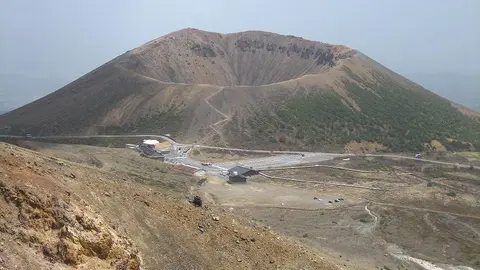
Okama is the centre of the view: a milky green crater lake in a ring of grey ash ridges and dark crater walls. Its colour comes from minerals in the acidic water and reads differently under cloud, in direct sun and after rain. Cloud tends to gather on the higher ridges as the day goes on, so the early hours are usually clearest, and from November the lake freezes and the whole crater turns white.
Green water in a ring of ash
The camera is on Katta-dake, one of the peaks around the crater, and looks down over Okama. In the foreground a slope of grass and low scrub falls towards the lake. Okama sits in the middle of the frame, its water a milky green, with a dark, shadowed crater wall rising behind it on the right and grey ash ridges around the rest. The higher ridge on the left is where cloud tends to gather, and distant ranges line the horizon on the right.
The colour comes from minerals in the lake's acidic water and changes with the light. From November the lake freezes and the whole crater turns white.
Snow monsters
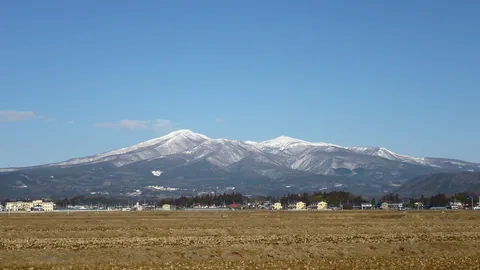
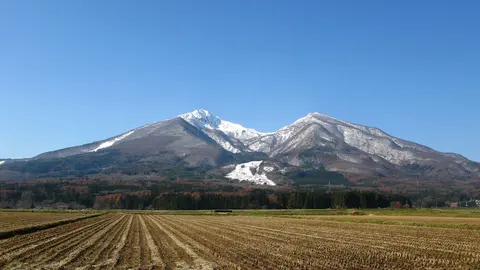
Zaō's other famous sight belongs to winter. On the Yamagata side the fir trees catch wet snow blown in from the Sea of Japan, which freezes on them layer by layer until each tree is a shapeless white figure two or three metres thick. They are called juhyō, snow monsters, they form reliably from late January to early March, and the ski resort lights them at night. The volcano itself last erupted in 1940 and has been quiet since, though the crater has periods of raised temperature and the alert level goes up from time to time.
When to watch Mount Zaō
Japan is nine hours ahead of UTC all year. Late spring to autumn is when the lake is open and its colour strongest; the clearest hours are early, before cloud gathers on the ridge. In winter the crater is closed and under snow, and the interest moves to the trees on the other side of the mountain.
Around Mount Zaō
The Zaō Echo Line crosses the range and the Zaō Highline branches off it to the crater. Zaō Onsen, on the Yamagata side, is a hot spring town with sulphurous water and the ski area; Tōgatta and Aone are the quieter spas on the Miyagi side.
Visiting Mount Zaō
A road reaches a car park a few minutes' walk from the crater rim, so Okama needs no climb at all. The Echo Line is closed by snow from about November to April. The alert level is worth checking, because access to the rim is restricted when it rises.