What you can see on the Unzen cams
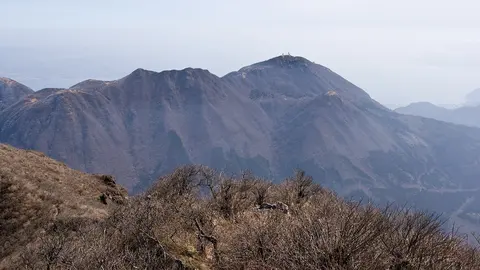
Unzen's summit area is a cluster of steep, bare, grey peaks scored with gullies, rising above wooded slopes and fields; the lava dome of Heisei-shinzan grew there during the eruption of 1990–1995. On cool days steam can still rise from the dome. Clear days in spring and autumn show the rocky crest best, while the early-summer rainy season often hides it.
The rocky summit of Unzen above the pines
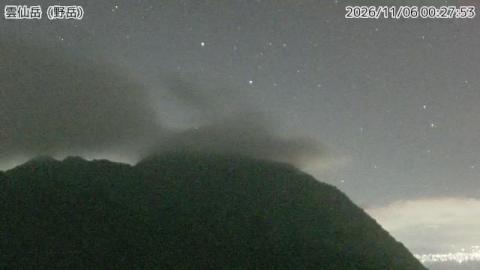
From Nodake, close to the summit area, the camera looks over a fringe of pines at a steep, rocky peak. Its slopes are bare and grey near the top, scored with gullies, and a jagged crest runs down to the right; a lower, rounded summit stands to the left. The caption 雲仙岳(野岳) gives the mountain and the station.
The summit area of Unzen holds Heisei-shinzan, the lava dome built during the eruption of 1990–1995, which reaches 1,483 m and is still closed to visitors. On cool days steam can rise from the dome.
Eruptions and disasters
In 1792, an earthquake linked to the volcano brought down part of Mayuyama, a mountain behind the town of Shimabara. The landslide fell into the sea and set off a tsunami that killed about 15,000 people around the Ariake Sea. Almost two centuries later, in 1990, Fugendake began to erupt. A growing lava dome shed thousands of pyroclastic flows, and on 3 June 1991 one of them killed 43 people, among them the volcanologists Maurice and Katia Krafft and Harry Glicken.
When to watch Unzen
Clear days in spring and autumn are best; in early summer, the rainy season often hides the peaks. Japan is nine hours ahead of UTC.
Around Unzen
Unzen Onsen, a hot spring village in the mountains, is known for its steaming “hells”, where volcanic gases rise from the ground. In Shimabara, the Mt. Unzen Disaster Memorial Hall tells the story of the 1990s eruption, and houses buried by mudflows have been preserved in a park. Unzen was among the first national parks of Japan, established in 1934.
Visiting Unzen
A ropeway climbs from Nita Pass towards Myōkendake, with views of the lava dome. The dome itself and the area around it remain closed to the public.