
What you can see on the Kujū cams
Kujū is a cluster of rounded peaks and ridges rather than a single cone, rising above grassland and woods in the middle of Kyushu. The thing to look for is the steam from the vents that opened on Hosshōzan in 1995, a thin white plume that shows best on cold, clear mornings. Close to the vents the ground is bare scree and grey rock, and in the last hour of daylight the ridgeline stands out dark against the sky.
The range in profile from Iida
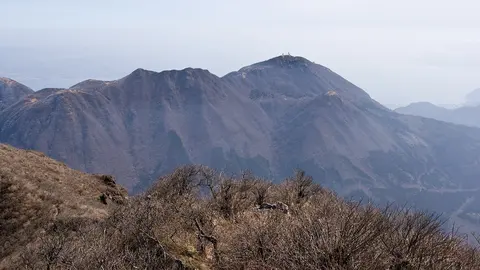
From Iida Ōhara the range lines up along the bottom of the picture as a row of peaks, from a lower rounded top on the left through several higher summits in the middle to a long ridge that fades out on the right. Closer, darker hills fill the foreground, and the top of a lattice tower pokes up at the bottom centre.
Seen side on and from further away than the other two cameras, the peaks stand out one behind another against the sky. Among them is Nakadake, at 1,791 m the highest point on Kyushu.
The Kujū summits over the Ueno woods
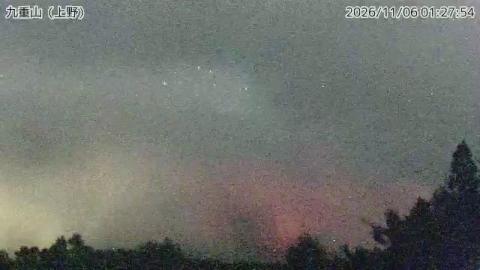
From Ueno the camera looks over a line of trees at the range: two big rounded peaks on the left, one behind the other, then a lower saddle and a long ridge with several tops running off to the right. Taller conifers stand at the right edge, close to the camera.
This is the widest of the three Kujū views and the one that shows how the summits line up. On clear days the steam from the vents that opened on Hosshōzan in 1995 can be seen from here as a thin white plume.
Bare scree and rock close to the 1995 vents
High on the northern ridge of Hosshōzan, this camera sits on a slope of loose, reddish scree that fills the right side of the frame. Beyond it, a bowl of bare grey rock and gravel opens out, crossed low on the left by pale lines that look like tracks, and a jagged ridge closes the skyline. There is almost no vegetation in sight.
The vents that opened in a steam explosion in October 1995 are close by, and their fumarole has been venting ever since.
The vent that opened in 1995
In October 1995 a steam explosion tore a new set of vents into the flank of Hosshōzan, the first eruption here since the eighteenth century. It threw ash over the hiking trails and left behind a fumarole that has been venting ever since, loudly enough to be heard from the path. That plume is now a permanent feature of the view and the thing the cameras are really watching. The last magma reached the surface about 1,600 years ago, when the Kurodake dome grew at the eastern end of the complex.
When to watch Kujū
The plume shows best on cold, clear mornings. Early June turns the upper slopes pink with Kyushu azaleas, and late October brings autumn colour to the moorland. Japan is nine hours ahead of UTC.
Around Kujū
The Tadewara and Bōgatsuru marshes at the foot of the range are protected wetlands on the Ramsar list, rare at this altitude in Japan. Kujū sits inside Aso-Kujū National Park, with the hot springs of Chōjabaru and Makinoto Pass nearby.
Visiting Kujū
The usual start is Makinoto Pass, with a path to Nakadake in about three hours return. The trails near the Hosshōzan vents are rerouted or closed whenever gas readings rise.