What you can see on the Mount Adatara cams
Adatara offers two scales: the long summit ridge seen as a whole, and the pale, bare crater basin where nothing grows and steam vents dot the floor. The steam is thin on warm afternoons and much denser when the air is cold and still. Snow arrives in November, whitening the ridge and making the shape of the crater rim far easier to read.
Inside the pale crater basin of Numanotaira
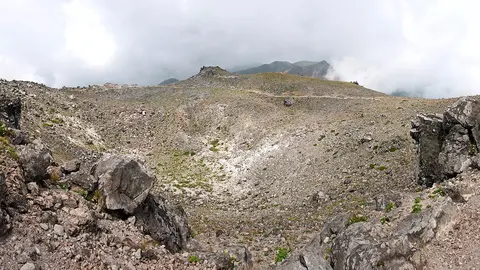
From Tetsuzan, a rocky high point on the rim, the camera looks straight down into Numanotaira, the crater basin of Mount Adatara. The near slope is ochre scrub and stones. Beyond it the floor of the basin opens out flat and pale, almost white, ringed by grey walls deeply grooved by erosion. On the right a lighter ridge of bare rock closes the bowl, and far behind, other ranges line the horizon.
Nothing grows on the crater floor. This is where the eruption of 1900 destroyed a sulphur mine and killed 72 people, and steam vents still dot the basin, showing best on cold, still days. Snow from November makes the rim easy to trace.
The long ridge from a distance
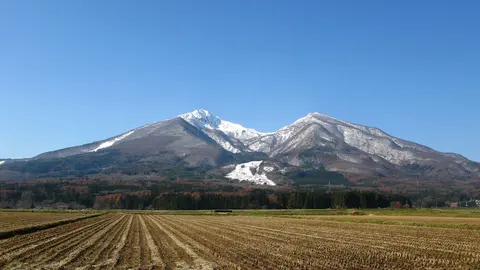
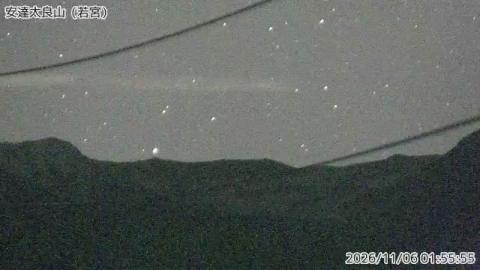
Far from the crater, this camera shows Mount Adatara as a long ridge across the lower part of the frame. A rounded peak stands at the left end, and a line of lower summits runs away to the right with a gentle dip in the middle. Two overhead cables cross the picture, one high and one low, and are part of every image.
This is the view for the mountain as a whole rather than the crater: how far down the cloud sits, how hazy the air is, and when the first snow whitens the ridge, usually in November. The Tetsuzan camera, by contrast, looks into the crater basin from close up.
The mine disaster of 1900
An eruption in 1900 destroyed a sulphur mine working inside the crater and killed 72 people, one of the deadliest volcanic events in modern Japanese history. The mine was never rebuilt. Smaller steam-driven activity has followed, most recently in the 1990s, and the crater area is monitored closely because the gas that collects there can be dangerous even when nothing is erupting.
When to watch Mount Adatara
Japan is nine hours ahead of UTC. Early morning gives the cleanest air and the strongest contrast on the crater walls. Steam shows up best on cold, still days; in midsummer heat it can be almost invisible even when the vents are active.
Around Mount Adatara
The mountain belongs to Bandai-Asahi National Park, which also takes in Mount Bandai and the lakes below it. Dake Onsen, on the eastern slope, has piped acidic water down from the volcano for centuries.
Visiting Mount Adatara
A ropeway from the eastern side shortens the climb considerably, and a network of trails runs along the ridge and around the crater rim. Signs mark where gas can accumulate and those sections should not be entered. The walking season runs from late spring to October.