Nature Live Cams

Mount Esan live cams

No recent report Stratovolcano in Hokkaido, Japan

Live image of Mount Esan: Esan crater floor

Esan crater floor

Source: Japan Meteorological Agency (JMA)

From the floor of the crater, facing the wall of rock that rings it. What you see

Mount Esan sits at the far eastern tip of the Kameda Peninsula, where southern Hokkaido runs out into the sea. At 618 metres it is one of the smaller volcanoes on this site, but what it lacks in height it makes up for on the crater floor, where sulphur fumaroles have been venting continuously for as long as records exist.

Mount Esan right now

Activity

No recent report

No automatic alert feed for this volcano. The observatory links below carry the latest reports.

Local time

–

Sunrise at 6:12 am, in 5 h 23 min.

Clouds over the summit

Mostly clear

16% cloud cover.

At the summit

2 °C (36 °F)

Wind 10 km/h (6 mph) from the W.

Forecast model values for the summit area from MET Norway, updated 15:03 UTC. Not a measurement.

Is Mount Esan erupting right now?

No eruption reported. Nothing has been reported for it in recent weekly volcanic activity reports from the Smithsonian and USGS. Checked November 4, 15:32 UTC.

When did Mount Esan last erupt?

Last eruption: 1874.

Earthquakes near Mount Esan

No earthquakes large enough to appear in the international catalogue have been recorded within 30 km (19 mi) of the summit in the last 30 days.

Source: EMSC. Updated November 4, 14:32 UTC. EMSC combines the catalogues of national seismic networks, but it mostly lists earthquakes large enough to be reported internationally; many small volcanic earthquakes are not included. Small earthquakes are common under active volcanoes and do not by themselves mean an eruption is coming.

What you can see on the Mount Esan cams

Esan is a volcano to watch from the inside: a crater basin ringed by grey, bare rock, where sulphur fumaroles stain the ground yellow and send steam drifting across it. On cold mornings the vapour is at its thickest; on warm afternoons it thins, and the colours of the rock and deposits come through instead. From further off, the rounded summit shows whether the headland is clear, under cloud or lost in sea fog.

Inside the crater basin, facing the morning sun

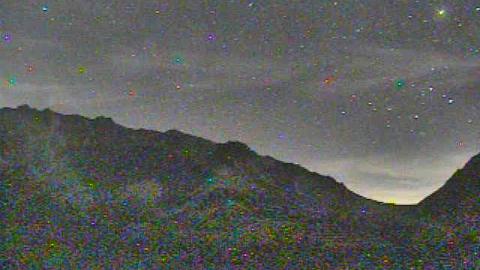
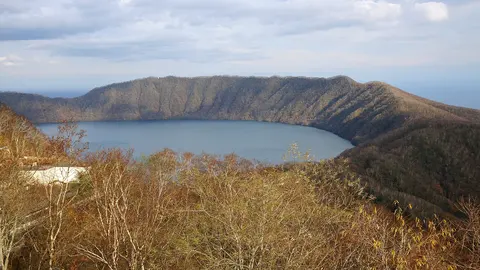
The camera stands on the floor of Mount Esan's crater basin and looks across it to the wall that encloses it. Low scrub and stony ground fill the foreground; behind, a long ridge of grey, bare rock curves across the frame from left to right and dips to a gap on the right-hand side. This is the basin where Esan's sulphur fumaroles vent, staining the ground yellow and sending steam drifting across it.

The camera faces roughly towards the morning sun, so early in the day the wall is in shadow and the sun can flare straight into the lens. Later, with the light behind the camera, the colours of the rock and the deposits come through.

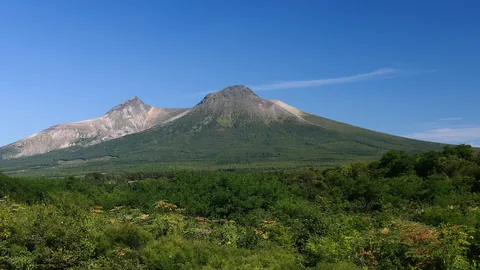
Mount Esan's summit on the skyline

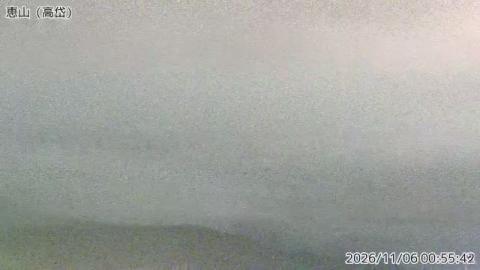
Where the crater camera puts you among the fumaroles, this one steps well back. The Japanese label names Takadai, and from there the rounded summit of Mount Esan rises along the bottom of the frame, with a pale patch near its top and a lower, darker ridge to its left. Above it is a wide stretch of open sky.

With the mountain taking up only the lower edge of the picture, this is a view for the weather over the headland rather than for detail. It shows at a glance whether the summit is clear, under cloud or lost in the sea fog that rolls in from the Pacific in early summer.

A volcano without a recent eruption

Esan last erupted in 1874, and the activity since has been limited to the fumaroles and the hot springs around the base. That makes it unusual among the volcanoes watched here: what the cameras show is not the run-up to anything, but the steady state of a volcano quietly venting gas, year after year. The colour of the deposits changes slowly with rain and temperature.

When to watch Mount Esan

Japan is nine hours ahead of UTC. Cold, still mornings give the most steam; that means winter dawns, when the contrast between the white vapour and the dark rock is strongest. Sea fog rolls in from the Pacific in early summer and can cover the whole headland.

Around Mount Esan

The slopes below the crater are covered with azaleas that flower in late spring, and the town of Esan holds a festival for them. Hakodate, with its harbour and night view from Mount Hakodate, is under two hours away by road.

Visiting Mount Esan

A road climbs to a car park partway up, and from there a short trail reaches the crater rim in about an hour. Gas concentrations can rise near the vents and the marked route keeps clear of them; signs at the trailhead give the current situation.
Volcano cams near Mount Esan

Mount Esan on the map

Mount Aso, Kumamoto, JapanAsoMount Fuji, Shizuoka and Yamanashi, JapanFujiMount Asama, Nagano and Gunma, JapanAsamaKirishima (Shinmoedake), Kagoshima and Miyazaki, JapanKirishimaKusatsu-Shirane, Gunma, JapanKusatsu-ShiraneMount Unzen, Nagasaki, JapanUnzenMount Tokachi, Hokkaido, JapanTokachiMount Iwate, Iwate, JapanIwateMount Hakkōda, Aomori, JapanHakkōdaMount Adatara, Fukushima, JapanAdataraMount Komagatake, Hokkaido, JapanKomagatakeMount Esan, Hokkaido, JapanEsanMount Zaō, Yamagata and Miyagi, JapanZaōMount Usu, Hokkaido, JapanUsuMount Bandai, Fukushima, JapanBandaiTaisetsuzan, Hokkaido, JapanTaisetsuzanKuttara, Hokkaido, JapanKuttaraAogashima, Izu Islands, Tokyo, JapanAogashimaMount Meakan, Hokkaido, JapanMeakanSatsuma-Iōjima, Kagoshima, JapanSatsuma-IōjimaAkita-Yakeyama, Akita, JapanAkita-YakeyamaAtosanupuri, Hokkaido, JapanAtosanupuriMount Chōkai, Akita and Yamagata, JapanChōkaiHachijōjima, Izu Islands, Tokyo, JapanHachijōjimaKuchinoerabujima, Kagoshima, JapanKuchinoerabujimaMount Kurikoma, Iwate, Miyagi and Akita, JapanKurikomaNakanoshima, Tokara Islands, Kagoshima, JapanNakanoshimaMount Nasu, Tochigi, JapanNasuMount Azuma, Fukushima, JapanAzumaMount Hakone, Kanagawa, JapanHakoneMount Haku, Ishikawa, JapanHakuMount Iwaki, Aomori, JapanIwakiIzu Ōshima, Tokyo, JapanIzu ŌshimaIzu-Tōbu, Shizuoka, JapanIzu-TōbuKōzushima, Tokyo, JapanKōzushimaMount Kujū, Oita, JapanKujūNiigata-Yakeyama, Niigata, JapanNiigata-YakeyamaNiijima, Tokyo, JapanNiijimaMount Nikkō-Shirane, Tochigi, JapanNikkō-ShiraneMount Norikura, Nagano, JapanNorikuraMount Ontake, Nagano, JapanOntakeMount Tarumae, Hokkaido, JapanTarumaeLake Towada, Aomori, JapanLake TowadaMount Tsurumi, Oita, JapanTsurumiSakurajima, Kagoshima, JapanSakurajimaSuwanosejima, Kagoshima (Tokara Islands), JapanSuwanosejima

More volcano cams in Japan