Nature Live Cams

Mount Hakkōda live cams

No recent report Stratovolcano in Aomori, Japan

Live image of Mount Hakkōda: Jigoku-numa pond, Mount Hakkōda

Jigoku-numa pond, Mount Hakkōda

Source: Japan Meteorological Agency (JMA)

Looking across Jigoku-numa, a warm pond fed by the volcano, with the Hakkōda peaks behind it. What you see

Mount Hakkōda is not one peak but a cluster of them at the northern tip of Honshū, a volcanic group whose highest summit, Ōdake, reaches 1,585 metres. Between the cones lie marshes, hot springs and warm ponds fed from below, and the whole range is known for receiving some of the deepest snow on earth.

Mount Hakkōda right now

Activity

No recent report

No automatic alert feed for this volcano. The observatory links below carry the latest reports.

Local time

–

Sunrise at 6:12 am, in 3 h 43 min.

Clouds over the summit

Overcast

100% cloud cover. Clearest in the next 24 hours: around 11:00 am (13%).

At the summit

4 °C (38 °F)

Wind 6 km/h (4 mph) from the SW.

Forecast model values for the summit area from MET Norway, updated 17:02 UTC. Not a measurement.

Is Mount Hakkōda erupting right now?

No eruption reported. Nothing has been reported for it in recent weekly volcanic activity reports from the Smithsonian and USGS. Checked November 5, 17:02 UTC.

Earthquakes near Mount Hakkōda

No earthquakes large enough to appear in the international catalogue have been recorded within 30 km (19 mi) of the summit in the last 30 days.

Source: EMSC. Updated November 5, 15:02 UTC. EMSC combines the catalogues of national seismic networks, but it mostly lists earthquakes large enough to be reported internationally; many small volcanic earthquakes are not included. Small earthquakes are common under active volcanoes and do not by themselves mean an eruption is coming.

What you can see on the Mount Hakkōda cams

Hakkōda gives two kinds of view: the warm ponds and hollows between its cones, where steam can drift over the water on cold mornings, and the line of rounded peaks, which shows whether the summits are clear. In summer the slopes are dense green; in October the low trees turn yellow and copper. From November the snow arrives and does not leave until May, some of the deepest anywhere on earth.

A warm pond below the Hakkōda peaks

The camera stands at the edge of Jigoku-numa, whose name means "hell pond", and looks across the water to the mountains. A railing and a strip of paved ground run along the bottom of the frame. The pond lies in a hollow ringed by low trees and shrubs, and the slopes behind it climb to a dark summit on the left and two rounded peaks further back in the middle.

The water is warm, fed from below by the volcano, and on cold mornings steam can drift across the surface. In October the trees around it turn yellow and copper; from November the hollow disappears under some of the deepest snow on earth.

A long, low look at the range

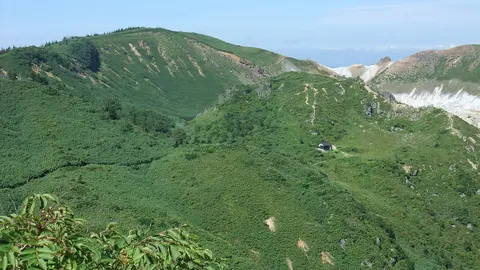
Unlike the pond camera, this one stands well back from the mountains and takes in the range as a whole. The peaks sit low on the horizon as a line of dark humps, with one higher, rounded summit in the middle, while a wooded slope rises across the right foreground. More than half of the frame is sky.

That much sky is the point: this is a view for reading the weather rather than the ground. It shows whether the summits are clear, where the cloud base sits and when the first snow reaches the tops. The image is small and turns dim under heavy cloud, so a bright day shows it best.

The gas that collects in the hollows

Carbon dioxide seeps from the ground across parts of Hakkōda and, being heavier than air, gathers in dips and snow hollows where there is no wind to clear it. The hazard is real and well signed, and the marked paths keep to safer ground. It is the reason why some attractive-looking dips on the mountain are fenced off rather than open.

When to watch Mount Hakkōda

Japan runs nine hours ahead of UTC. Mornings are generally clearest. Cloud from the Sea of Japan often covers the range for days at a time in winter, so patience helps; the reward is the snow-laden forest on a bright day, which is unlike anything else in the country.

Around Mount Hakkōda

The range sits inside Towada-Hachimantai National Park, within an hour of Aomori city. Sukayu, on the western side, is one of Japan's oldest hot-spring inns and gives its name to the road that crosses the mountains.

Visiting Mount Hakkōda

A ropeway climbs the northern side and runs most of the year, putting the upper slopes within reach without a long walk. Marked trails link the peaks and the ponds in summer. In winter this is avalanche country and the routes need proper equipment and local knowledge.

Volcano cams near Mount Hakkōda

Mount Hakkōda on the map

Mount Aso, Kumamoto, JapanAsoMount Fuji, Shizuoka and Yamanashi, JapanFujiMount Asama, Nagano and Gunma, JapanAsamaKirishima (Shinmoedake), Kagoshima and Miyazaki, JapanKirishimaKusatsu-Shirane, Gunma, JapanKusatsu-ShiraneMount Unzen, Nagasaki, JapanUnzenMount Tokachi, Hokkaido, JapanTokachiMount Iwate, Iwate, JapanIwateMount Hakkōda, Aomori, JapanHakkōdaMount Adatara, Fukushima, JapanAdataraMount Komagatake, Hokkaido, JapanKomagatakeMount Esan, Hokkaido, JapanEsanMount Zaō, Yamagata and Miyagi, JapanZaōMount Usu, Hokkaido, JapanUsuMount Bandai, Fukushima, JapanBandaiTaisetsuzan, Hokkaido, JapanTaisetsuzanKuttara, Hokkaido, JapanKuttaraAogashima, Izu Islands, Tokyo, JapanAogashimaMount Meakan, Hokkaido, JapanMeakanSatsuma-Iōjima, Kagoshima, JapanSatsuma-IōjimaAkita-Yakeyama, Akita, JapanAkita-YakeyamaAtosanupuri, Hokkaido, JapanAtosanupuriMount Chōkai, Akita and Yamagata, JapanChōkaiHachijōjima, Izu Islands, Tokyo, JapanHachijōjimaKuchinoerabujima, Kagoshima, JapanKuchinoerabujimaMount Kurikoma, Iwate, Miyagi and Akita, JapanKurikomaNakanoshima, Tokara Islands, Kagoshima, JapanNakanoshimaMount Nasu, Tochigi, JapanNasuMount Azuma, Fukushima, JapanAzumaMount Hakone, Kanagawa, JapanHakoneMount Haku, Ishikawa, JapanHakuMount Iwaki, Aomori, JapanIwakiIzu Ōshima, Tokyo, JapanIzu ŌshimaIzu-Tōbu, Shizuoka, JapanIzu-TōbuKōzushima, Tokyo, JapanKōzushimaMount Kujū, Oita, JapanKujūNiigata-Yakeyama, Niigata, JapanNiigata-YakeyamaNiijima, Tokyo, JapanNiijimaMount Nikkō-Shirane, Tochigi, JapanNikkō-ShiraneMount Norikura, Nagano, JapanNorikuraMount Ontake, Nagano, JapanOntakeMount Tarumae, Hokkaido, JapanTarumaeLake Towada, Aomori, JapanLake TowadaMount Tsurumi, Oita, JapanTsurumiSakurajima, Kagoshima, JapanSakurajimaSuwanosejima, Kagoshima (Tokara Islands), JapanSuwanosejima

More volcano cams in Japan