
What you can see on the Fuji cams
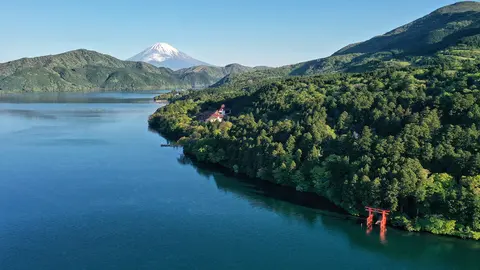
Fuji rises alone above the Fuji Five Lakes, with forest and lakeshore at its foot and, in winter, a snow cap that stands out above the dark shores. The light changes the view through the day: depending on the angle, the morning sun either lights the slopes or turns the cone into a soft, hazy silhouette. Clear winter mornings are hard to beat, while in summer haze and cloud can hide the mountain for days.
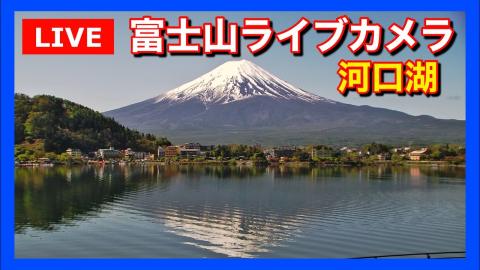
Fuji's north face across the lake and its hotel shore
The camera stands on the shore of Lake Kawaguchi and looks across open water to Mount Fuji, which rises alone behind the far bank. A wooded hill drops to the lake on the left, and a line of hotels, houses and trees runs along the opposite shore at the foot of the mountain. Boats sometimes cross the lake in front.
From this side the 3,776 m cone looks almost perfectly even. In the morning the camera faces the light and the mountain shows as a soft, hazy outline; the best days are clear winter mornings, when the snow cap stands out above the dark shore.
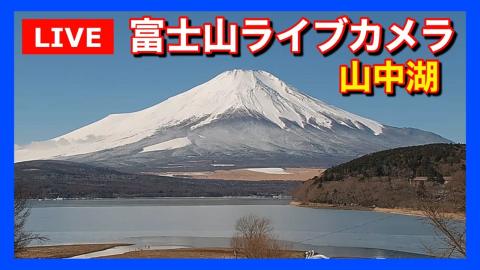
The whole mountain above Lake Yamanaka
From a grassy bank on Lake Yamanaka, this view takes in Fuji from the summit down to the forest at its base. The lake fills the middle of the frame, with a wooded point running in from the right and a dark line of forest along the far shore. Between that forest and the cone, a pale band of open ground lies at the foot of the slopes, and the mountain's long right-hand shoulder slopes gently away.
Morning light falls on the slopes here rather than behind them. This is also the lake where, from mid-October to late February, the sun sets right behind the summit on some evenings, the sight known as Diamond Fuji.
Fuji above a lake ringed by steep wooded hills
This camera looks down from high ground over a long lake held between steep, wooded slopes, with Mount Fuji rising beyond the far end. Treetops edge the bottom of the frame, a dark ridge climbs on the right, and lower hills on the left frame the cone between them. In the morning the camera faces into the sun: the mountain shows as a grey silhouette and the light lays a bright path across the water.
It is a different picture from the lakeshore views, higher up, with the whole lake below and Fuji framed by the nearer hills. The stream comes from Yamanashi's regional television station.
A dormant volcano
Fuji last erupted in 1707, in the Hōei eruption, which covered Edo, today’s Tokyo, in ash. It hasn’t erupted since, but it is classified as active, and the Japan Meteorological Agency monitors it continuously.
When to watch Fuji
Winter, from December to February, brings the clearest skies and the most snow on the cone; early mornings are best. In summer the mountain is often hidden by haze and cloud for days. From Lake Yamanaka, between mid-October and late February, the sun sets right behind the summit on some days, a sight known as Diamond Fuji. The cloud forecast on this page tells you when the next clear spell is due.
Around Fuji
The Fuji Five Lakes, on the northern side, are the classic places to see the mountain reflected in the water. From the Chureito Pagoda above Fujiyoshida, Fuji rises behind a five-storey pagoda, especially popular in cherry blossom season. Aokigahara, the forest that grows on a lava flow from the year 864, and the spring-fed ponds of Oshino Hakkai are close by.
Visiting Fuji
The official climbing season runs from early July to early September. Outside it, the upper trails are closed and dangerous.