What you can see on the Kirishima cams
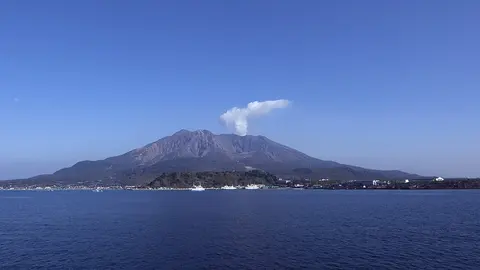
The range holds more than 20 volcanoes, but the one most watched is Shinmoedake, a broad, flat-topped cone whose crater is hidden behind its rim, so what shows is whatever rises above it. On quiet days that may be a thin plume of steam; during eruptions, grey ash columns climb high into the sky and, at night, the summit can glow. Cloud and mist often sit on the range, and clear mornings in autumn and winter give the sharpest views.
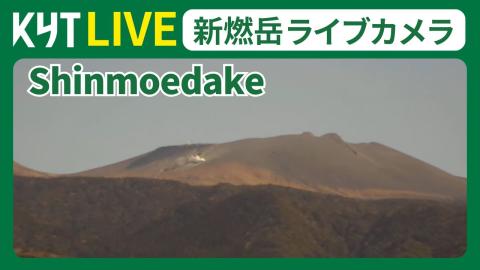
Shinmoedake's broad summit in close-up
A telephoto view picks out Shinmoedake on its own: a wide, flat-topped cone whose upper slopes are bare, with a few rocky knobs along the summit rim on the right. Darker, forested ridges fill the lower part of the frame. The crater itself is hidden behind the rim, so what shows from here is whatever rises above it.
The picture comes from KYT, a regional television station in Kagoshima, and its close framing makes even a thin plume over the rim easy to spot. Shinmoedake, 1,421 m high, had its largest eruption in about 300 years in 2011 and erupted again in 2017, 2018 and 2025.
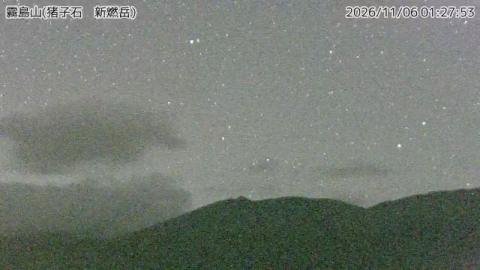
Shinmoedake between its neighbours
From Ikoishi, Shinmoedake appears as a low, flat-topped cone in the middle of the frame, with a pale scar near the left end of its summit. Neighbouring peaks of the Kirishima range flank it, a rounded hill on the left and a broader slope on the right, and a dark band of forest runs along the bottom. Most of the picture is sky, which leaves room to see how high a plume rises.
A Japanese caption, 霧島山(猪子石 新燃岳), names the station and the volcano. Compared with the television close-up, this wider frame shows where the cone sits among the other volcanoes of the range.
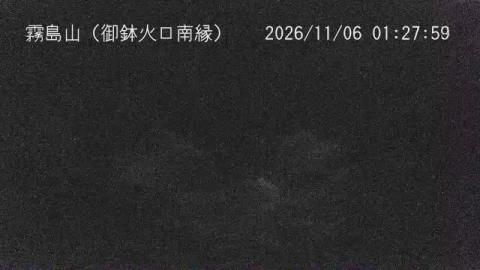
Looking down into the Ohachi crater
Here the camera stands on the south rim of Ohachi and looks straight down into the crater. Reddish, broken lava rock covers the rim in the foreground, the inner walls drop steeply on both sides, and the floor far below is pale grey and white, scattered with dark boulders. Patches of green grass cling to the upper wall on the left.
Ohachi is a separate active crater of the Kirishima range, and this is the only Kirishima camera that looks into a crater rather than at a mountain. In the early morning the sun lights one wall and leaves the rest in shadow; the floor is clearest when the sun is high.
Eruptions of Kirishima
In January 2011, Shinmoedake produced its largest eruption in about 300 years, with explosive blasts that spread ash across the region and a lava dome that filled its crater within days. It erupted again in 2017 and 2018, and once more in 2025 after a period of unrest. The Japan Meteorological Agency sets separate alert levels for Shinmoedake and for other vents of the range.
When to watch Kirishima
Clear mornings, especially in autumn and winter, give the best views. Kyushu’s rainy season, from June to July, often hides the mountains. Japan is nine hours ahead of UTC.
Around Kirishima
The range lies in Kirishima-Kinkōwan National Park and is surrounded by hot spring villages. Ebino Plateau, in the north of the range, has hiking trails, crater lakes and bright autumn colours. Kirishima Shrine, at the foot of the mountains, is linked to one of the founding legends of Japan, in which the grandson of the sun goddess descended onto the peak of Takachiho-no-mine.
Visiting Kirishima
Trails close to Shinmoedake and other active vents close whenever the alert level is raised. Check the Japan Meteorological Agency’s warnings and the local restrictions before hiking.