Nature Live Cams

Kirishima (Shinmoedake) live cams

No recent report Stratovolcano in Kagoshima and Miyazaki, Japan

Shinmoedake, live

Source: KYT Kagoshima Yomiuri Television

A live view of Shinmoedake from the regional television station in Kagoshima. What you see

Kirishima is a group of more than 20 volcanoes on the border of Kagoshima and Miyazaki prefectures, in southern Kyushu. Its most active cone is Shinmoedake, 1,421 m (4,662 ft) high, whose crater has filled with lava more than once in recent years.

Kirishima right now

Activity

No recent report

No automatic alert feed for this volcano. The observatory links below carry the latest reports.

Local time

–

Sunrise at 6:36 am, in 4 h 29 min.

Clouds over the summit

Clear sky

8% cloud cover.

At the summit

7 °C (45 °F)

Wind 22 km/h (13 mph) from the NW.

Forecast model values for the summit area from MET Norway, updated 17:02 UTC. Not a measurement.

Is Kirishima (Shinmoedake) erupting right now?

No eruption reported. Nothing has been reported for it in recent weekly volcanic activity reports from the Smithsonian and USGS. Checked November 5, 17:02 UTC.

When did Kirishima (Shinmoedake) last erupt?

Recent eruptions: 2017–2018 and 2025.

Earthquakes near Kirishima (Shinmoedake)

No earthquakes large enough to appear in the international catalogue have been recorded within 30 km (19 mi) of the summit in the last 30 days.

Source: EMSC. Updated November 5, 14:32 UTC. EMSC combines the catalogues of national seismic networks, but it mostly lists earthquakes large enough to be reported internationally; many small volcanic earthquakes are not included. Small earthquakes are common under active volcanoes and do not by themselves mean an eruption is coming.

What you can see on the Kirishima cams

The range holds more than 20 volcanoes, but the one most watched is Shinmoedake, a broad, flat-topped cone whose crater is hidden behind its rim, so what shows is whatever rises above it. On quiet days that may be a thin plume of steam; during eruptions, grey ash columns climb high into the sky and, at night, the summit can glow. Cloud and mist often sit on the range, and clear mornings in autumn and winter give the sharpest views.

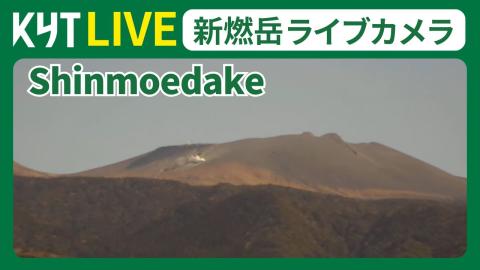
Shinmoedake's broad summit in close-up

A telephoto view picks out Shinmoedake on its own: a wide, flat-topped cone whose upper slopes are bare, with a few rocky knobs along the summit rim on the right. Darker, forested ridges fill the lower part of the frame. The crater itself is hidden behind the rim, so what shows from here is whatever rises above it.

The picture comes from KYT, a regional television station in Kagoshima, and its close framing makes even a thin plume over the rim easy to spot. Shinmoedake, 1,421 m high, had its largest eruption in about 300 years in 2011 and erupted again in 2017, 2018 and 2025.

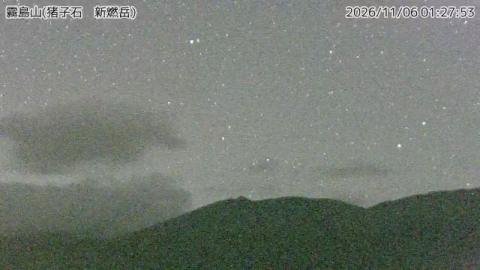
Shinmoedake between its neighbours

From Ikoishi, Shinmoedake appears as a low, flat-topped cone in the middle of the frame, with a pale scar near the left end of its summit. Neighbouring peaks of the Kirishima range flank it, a rounded hill on the left and a broader slope on the right, and a dark band of forest runs along the bottom. Most of the picture is sky, which leaves room to see how high a plume rises.

A Japanese caption, 霧島山(猪子石 新燃岳), names the station and the volcano. Compared with the television close-up, this wider frame shows where the cone sits among the other volcanoes of the range.

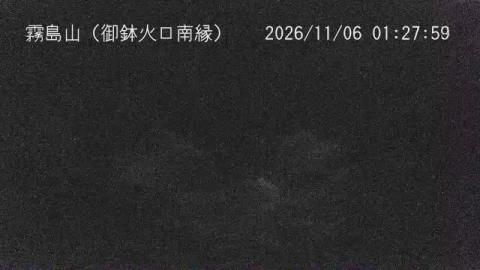
Looking down into the Ohachi crater

Here the camera stands on the south rim of Ohachi and looks straight down into the crater. Reddish, broken lava rock covers the rim in the foreground, the inner walls drop steeply on both sides, and the floor far below is pale grey and white, scattered with dark boulders. Patches of green grass cling to the upper wall on the left.

Ohachi is a separate active crater of the Kirishima range, and this is the only Kirishima camera that looks into a crater rather than at a mountain. In the early morning the sun lights one wall and leaves the rest in shadow; the floor is clearest when the sun is high.

Eruptions of Kirishima

In January 2011, Shinmoedake produced its largest eruption in about 300 years, with explosive blasts that spread ash across the region and a lava dome that filled its crater within days. It erupted again in 2017 and 2018, and once more in 2025 after a period of unrest. The Japan Meteorological Agency sets separate alert levels for Shinmoedake and for other vents of the range.

When to watch Kirishima

Clear mornings, especially in autumn and winter, give the best views. Kyushu’s rainy season, from June to July, often hides the mountains. Japan is nine hours ahead of UTC.

Around Kirishima

The range lies in Kirishima-Kinkōwan National Park and is surrounded by hot spring villages. Ebino Plateau, in the north of the range, has hiking trails, crater lakes and bright autumn colours. Kirishima Shrine, at the foot of the mountains, is linked to one of the founding legends of Japan, in which the grandson of the sun goddess descended onto the peak of Takachiho-no-mine.

Visiting Kirishima

Trails close to Shinmoedake and other active vents close whenever the alert level is raised. Check the Japan Meteorological Agency’s warnings and the local restrictions before hiking.
Volcano cams near Kirishima

Kirishima on the map

Mount Aso, Kumamoto, JapanAsoMount Fuji, Shizuoka and Yamanashi, JapanFujiMount Asama, Nagano and Gunma, JapanAsamaKirishima (Shinmoedake), Kagoshima and Miyazaki, JapanKirishimaKusatsu-Shirane, Gunma, JapanKusatsu-ShiraneMount Unzen, Nagasaki, JapanUnzenMount Tokachi, Hokkaido, JapanTokachiMount Iwate, Iwate, JapanIwateMount Hakkōda, Aomori, JapanHakkōdaMount Adatara, Fukushima, JapanAdataraMount Komagatake, Hokkaido, JapanKomagatakeMount Esan, Hokkaido, JapanEsanMount Zaō, Yamagata and Miyagi, JapanZaōMount Usu, Hokkaido, JapanUsuMount Bandai, Fukushima, JapanBandaiTaisetsuzan, Hokkaido, JapanTaisetsuzanKuttara, Hokkaido, JapanKuttaraAogashima, Izu Islands, Tokyo, JapanAogashimaMount Meakan, Hokkaido, JapanMeakanSatsuma-Iōjima, Kagoshima, JapanSatsuma-IōjimaAkita-Yakeyama, Akita, JapanAkita-YakeyamaAtosanupuri, Hokkaido, JapanAtosanupuriMount Chōkai, Akita and Yamagata, JapanChōkaiHachijōjima, Izu Islands, Tokyo, JapanHachijōjimaKuchinoerabujima, Kagoshima, JapanKuchinoerabujimaMount Kurikoma, Iwate, Miyagi and Akita, JapanKurikomaNakanoshima, Tokara Islands, Kagoshima, JapanNakanoshimaMount Nasu, Tochigi, JapanNasuMount Azuma, Fukushima, JapanAzumaMount Hakone, Kanagawa, JapanHakoneMount Haku, Ishikawa, JapanHakuMount Iwaki, Aomori, JapanIwakiIzu Ōshima, Tokyo, JapanIzu ŌshimaIzu-Tōbu, Shizuoka, JapanIzu-TōbuKōzushima, Tokyo, JapanKōzushimaMount Kujū, Oita, JapanKujūNiigata-Yakeyama, Niigata, JapanNiigata-YakeyamaNiijima, Tokyo, JapanNiijimaMount Nikkō-Shirane, Tochigi, JapanNikkō-ShiraneMount Norikura, Nagano, JapanNorikuraMount Ontake, Nagano, JapanOntakeMount Tarumae, Hokkaido, JapanTarumaeLake Towada, Aomori, JapanLake TowadaMount Tsurumi, Oita, JapanTsurumiSakurajima, Kagoshima, JapanSakurajimaSuwanosejima, Kagoshima (Tokara Islands), JapanSuwanosejima

More volcano cams in Japan